


Sequence control is a method used to execute operations according to a predetermined order or logic. In the context of power supplies, it automates output patterns by changing voltage and current settings over time. This involves Step changes (discrete increments) or smooth Ramp transitions. Unlike standard operation where a user manually sets a constant output, sequence control allows the power supply to autonomously follow a programmed profile.
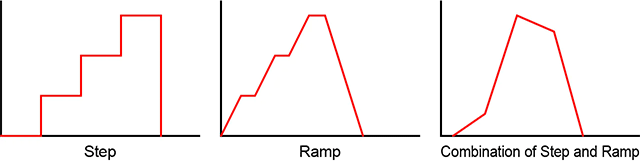
Sequence control is essential for reproducing dynamic power environments. While a standard power supply maintains a fixed output, a sequence-enabled unit can simulate fluctuating conditions, such as the voltage drop during engine ignition or the charge-discharge cycles of a battery. This capability allows for complex testing without the need for continuous manual adjustment or external computer control.
In power supply applications, sequence control is a powerful feature that allows users to create and automate complex output patterns. By programming a series of voltage and current settings over time, users can simulate real-world power conditions, automate repetitive tests, and precisely manage power delivery to a device under test (DUT).
Matsusada Precision offers a wide range of programmable DC power supplies, high-voltage power supplies, and electronic loads featuring built-in sequence functions. Users can program complex patterns--combining steps, ramps, and loops--directly into the unit. This stand-alone capability eliminates the need for a dedicated PC or external controller during operation, simplifying test setups and ensuring high-speed execution unaffected by communication latency.
These features are ideal for R&D and production lines requiring precise automation, such as automotive component testing, battery simulation, and semiconductor evaluation. Key models include:
This advanced sequence control is essential for cutting-edge R&D and production lines, including automotive component testing, battery charge/discharge simulation, and semiconductor manufacturing processes. Key models featuring this powerful sequence function include:
DC Power Supplies: R4K-36, R4KF-80, R4K-80, R4GT, PKTS, TB, RK, PVCE, PRKT, RKT, REK/REKJ, PRT/PRTM, PBR/PBRM
High-Voltage Power Supplies: EPR, HARS
Related Technical Articles
- What is PID Control? An Introduction to Automatic Control
- What is a Power Supply? Types and Applications
- What is a Power Supply? (Basic Knowledge)
- Safety and Usage of High Voltage Power Supply
- An Introduction to DC Power Supplies
- What is a Bipolar Power Supply? (Basic Knowledge)
- Electronic Loads: An Introduction to Principles, Types, and Uses
- What is an AC Power Source? - Basic Knowledge -
- Linear vs. Switching Power Supplies: Key Differences Explained
- Types of X-ray Tubes and High-voltage Power Supplies
- High Voltage Measurement Method
- How to Choose a DC Power Supply: Key Points to Consider
- Difference between DC power and AC power
- A Beginner's Guide to Using Power Supplies Safely
- A Guide to Using DC Power Supplies Correctly and Safely
- HVPS for Lab Analyzers: Key Considerations for Stability and Noise
- Amplifier Basics: Principles, Operation, and Key Considerations
- Method of Generating Direct Current (DC) Power