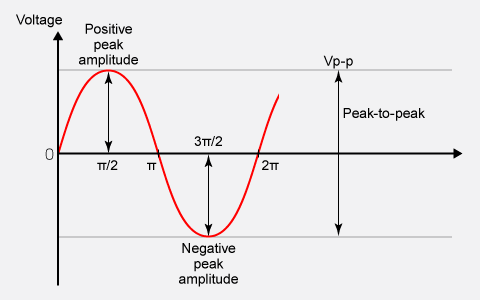

Peak-to-peak (often abbreviated as p-p, or Vpp for voltage) represents the absolute difference between the maximum (positive peak) and minimum (negative peak) values of a waveform.
This value quantifies the total swing of a signal. While "amplitude" typically refers to the peak value measured from zero, peak-to-peak measures the full extent from the lowest to the highest point. In the context of DC power supplies, peak-to-peak is a critical metric used to specify ripple and noise, describing the maximum fluctuation on the output line.
For a symmetric periodic waveform centered around zero, such as the sine wave shown below, the peak-to-peak value is exactly twice the peak amplitude.