

What is an AC Power Source / AC Power Supply?
An AC source (also referred to as an AC power supply) is a device that provides alternating current (AC) with controllable voltage and frequency. While standard wall outlets provide a fixed AC supply, a regulated AC source allows users to simulate various power conditions for testing purposes.
Commercial AC power supplied from a standard wall outlet does not always maintain a constant voltage. It is subject to voltage fluctuations caused by changes in the power consumption of other connected devices and may experience momentary power interruptions.
Since these fluctuations are not large, they do not pose much of a problem for home appliances with simple structures such as lighting. However, in the case of devices with electronic circuits or precision instruments, it can lead to problems such as malfunctions. Therefore, a stabilized AC power supply is necessary to eliminate the effects of voltage fluctuations.
Also, unlike an electrical outlet, a regulated AC-to-AC power source can supply a variety of voltages and frequencies. For this reason, they are also used to simulate situations where there is a possibility of malfunctions such as instantaneous voltage dips, harmonic generation, and surges in the testing of electronic equipment.
As mentioned earlier, the electricity supplied from the power supply contains various fluctuations, so it is necessary to check in advance that the device under test (DUT) will not malfunction in such an environment. An AC power source is also used for this check. When conducting power supply tests, an AC power supply is suitable for the actual device under test and specific tests are required for each scenario.
Furthermore, this property can be used to reproduce AC power outlets in countries around the world. When making electronic devices with AC input that are used all over the world, stabilized AC power sources are used to test the AC input range according to the power supply conditions of each country and the voltage with the corresponding error.
The following three properties are required of an AC power source.
- Stable output voltage.
- High output waveform quality, unaffected by input voltage fluctuations.
- Stable power delivery regardless of load type or load changes.
In electrical testing, the choice between AC and DC power depends entirely on the requirements of the device under test (DUT). While DC power sources provide a constant, unidirectional voltage, an AC power source must ensure stability not only in voltage but also in the output waveform and frequency. Both are essential tools, but they serve fundamentally different roles in circuit validation.
Types of AC Power Sources
AC voltage and frequency converters can be broadly categorized into two types. One is direct AC-AC conversion (single stage), and the other is AC to DC to AC (two-stage) type that converts AC to DC (1st stage) and then converts the DC to AC (2nd stage).
Each type has several conversion methods, each with its own advantages and disadvantages. The characteristics of each method are summarized below.
| Type | Method | Size | Efficiency | Cost | Response time | Distortion factor | Waveform Quality | Voltage Adjustment | Other features | Products |
|---|---|---|---|---|---|---|---|---|---|---|
|
Direct AC-AC conversion (single stage) [AC voltage converter] Example: Automatic Voltage Regulator (AVR) |
AC Stabilizer | Large | High | Low | Slow | Depends on the AC line quality | Automatic | |||
| Variable Autotransformer (e.g., Variac) |
Large | High | Low | - | Depends on the AC line quality | Manual | ||||
| Tap Changer | Large | High | Low | Slow | Depends on the AC line quality | Step/continuous | ||||
|
AC to DC to AC conversion (two-stage) [AC voltage and Frequency converter] Example: AC power source Programmable AC power source |
Linear amplifier | Middle | Low | Expensive | Fastest | Lowest | Best (pristine signal) | Precise electronic control |
High Quality waveform Output voltage and frequency can be changed at any timing |
|
| Switching Inverter | Small | Moderate | Moderate | Fast | Moderate | Good (modern PWM) | Precise electronic control | Good balance of waveform quality, size, efficiency, and cost | DRK series, DRS series, DRJ series | |
Product introduction of recommended AC power source
So, how should a beginner choose an AC power source? First, let's take a look at the current trends. In recent years, AC power supplies have tended to become smaller and smaller, and there is also a demand for more efficient power supplies from the perspective of environmental protection.
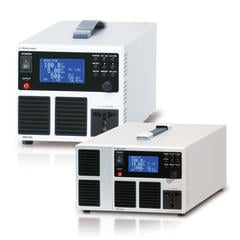
In response to this situation, Matsusada Precision has developed a benchtop AC Power Source that is more compact than other companies' products. In response to these requirements, Matsusada Precision has developed benchtop AC Power Sources that are significantly more compact than conventional models. The series features a lightweight, portable design that allows for easy relocation within the lab.
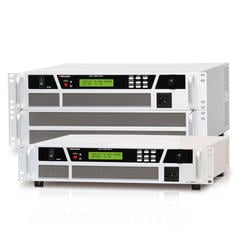
The DRK series is Matsusada Precision's flagship model, offering not only high-quality output power, but also small size, lightweight, and high efficiency.
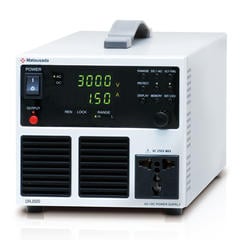
The DRJ series is capable of outputting DC voltage as well as AC voltage and has a universal power output terminal (electrical outlet) that is convenient for worldwide product development and testing.
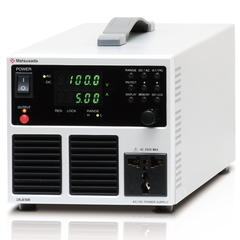
On the other hand, the DRJE series has simple features. It is also important to note that, unlike the other AC power source models, it can only provide AC output.
The features of each series can be summarized as follows.
| Single phase AC output | Three phase AC output | DC output | |
| High-power, multi-function DRK series | |||
| Benchtop size and high performance DRS series | |||
| Benchtop size, multi-function DRJ series | |||
| Benchtop size, Simple DRJE series |
When selecting phase AC power sources, it is important to verify whether your application requires a single-phase or three-phase configuration. While many compact AC power sources offer only single-phase output, Matsusada Precision's compatible models can be configured to provide three-phase AC by linking three units together, providing flexibility for industrial-grade testing.
We recommend the high-power DRK series, but you should also consider the nature of the test you need to perform and the location where it will be installed.
Related Technical Articles
Recommended products
Matsusada Precision's high-performance AC power sources