


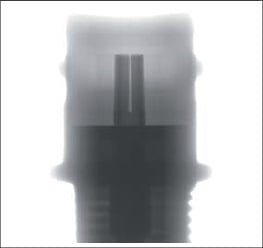
Insert molding is a process that integrates metal components, such as terminals, into resin or rubber. While insert molded products may appear flawless externally, internal defects--such as metal-to-metal contact causing short circuits or voids in the resin weakening structural integrity--can occur. Therefore, non-destructive X-ray inspection is essential to verify internal quality. These components are widely used in electronic devices, including terminals, connectors, switches, gears, and enclosures.
Effective inspection requires a system capable of high tube voltage to penetrate dense metal components, combined with a high-resolution camera to detect minute shapes and voids within the resin.
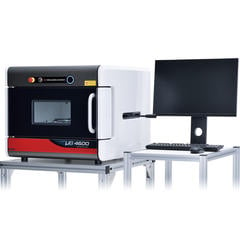
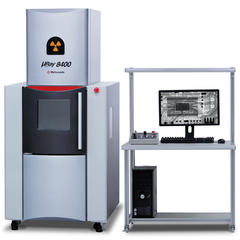
The precision μB4600 benchtop X-ray inspection system offers flexible configurations for X-ray tube voltage and camera specifications to meet diverse requirements. For applications involving thick metal parts, a 100 kV tube voltage model is available for enhanced penetration. Additionally, an advanced configuration featuring a 60 kV tube and a 3-megapixel camera allows for high-resolution inspection over a wider field of view.
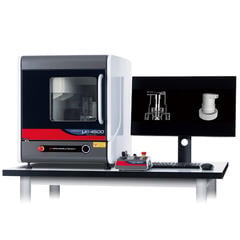
For 3D analysis, the precision μB4500 X-ray CT-compatible system features a metal artifact reduction function. This technology minimizes noise caused by metal components, enabling clear visualization of the resin-metal interface.
| Focal Spot | Microfocus |
|---|---|
| X-ray Tube Voltage | 60 to 130 kV |
| Magnification | 1 to 100x |
Recommended products
Related Technical Articles
- Selecting an X-ray Inspection System
- Principles of Radiography
- Safe Operation of X-ray Inspection Systems
- Basics and Principles of Computed Tomography (CT)
- Non-Destructive Testing: Types and Applications
- What are X-rays? (Basic Knowledge)
- How to Acquire High-Quality Computed Tomography (CT) Images - X-ray NDT series (1)
- A Guide to X-ray CT Images: Formats, Viewing, and Applications - X-ray NDT series (2)
- X-ray Image Processing and Automated Inspection - X-ray NDT series (3)
- What is the difference between Radioactivity, Radiation, and Radioactive Materials?
- Understanding Radiation: Effects on the Body and X-ray Safety