
X-rays are a form of electromagnetic radiation, positioned between ultraviolet light and gamma rays in the electromagnetic spectrum. They have a shorter wavelength and higher energy than ultraviolet light.
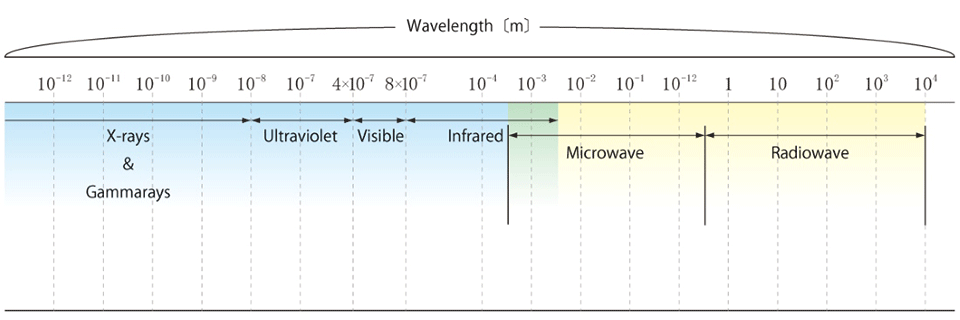
While visible light is blocked by opaque objects, X-rays possess short wavelengths and high energy, enabling them to penetrate various materials. The degree of penetration depends on the density and atomic number of the object.
This penetrating ability is utilized in non-destructive testing (NDT), such as using an X-ray inspection system for fill-level checks and foreign material detection.
In addition, by rotating the X-ray source or the target object 360 degrees, cross-sectional and volumetric 3D images can be reconstructed. This technology is known as X-ray CT (Computed Tomography).
The X-ray tube units that generate X-rays are categorized by their focal spot size:
- Milli-focus X-ray
- Mini-focus X-ray
- Micro-focus X-ray
For more information about these products, please visit the X-Ray Tube Units or X-Ray Inspection Systems/X-Ray CT pages.
If you have specific requirements or need assistance selecting the right model for your application, please contact us.
Contact US
Related Technical Articles
- What is the difference between radioactivity, radiation, and radioactive materials?
- Understanding Radiation: Effects on the Body and X-ray Safety
- Principles of Radiography
- Non-Destructive Testing: Types and Applications
- FAQ: What is the tube voltage or acceleration voltage necessary for X-ray inspection systems?
Recommended products
Present our X-ray Inspection system and high voltage X-ray technology products