


Optical lenses use materials like glass to converge light through refraction. In contrast, electron lenses use electric or magnetic fields to focus and manipulate electron or ion beams.
Electron lenses are broadly classified into electrostatic lenses and electromagnetic lenses. While optical lenses include both concave and convex lenses, rotationally symmetric electric and magnetic field lenses fundamentally function only as convex (converging) lenses. One common type of electrostatic lens consists of three coaxial electrodes, where the center electrode is biased at a different potential from the two outer electrodes. This voltage distribution forms curved equipotential surfaces that act as an electrostatic lens.
Charged particles experience a force in the direction of the electric field, which is perpendicular to the equipotential surfaces. As a result, their trajectories can be precisely controlled by shaping the electric field through the electrode geometry.
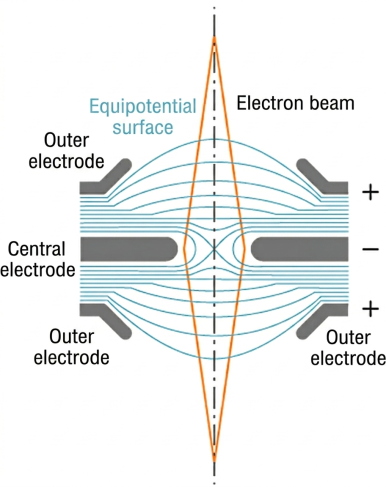
Electron lenses are widely used in scanning electron microscopes (SEMs), transmission electron microscopes (TEMs), focused ion beam (FIB) systems, electron beam lithography equipment, and electron beam welding systems. In a scanning electron microscope, an electron beam emitted from an electron gun in the microscope column is converged by an electron lens to scan the surface of the sample. Furthermore, secondary or backscattered electrons emitted from the sample are captured by a detector and reconstructed into an image.
- Related Terms:
-
- Electrostatic Lens
- Electromagnetic Lens
- Electron Optics
- Electron Gun
- Electron Beam
- Ion Beam
- Focused Ion Beam (FIB)
- Scanning Electron Microscope (SEM)
- Transmission Electron Microscope (TEM)
- Electrode
Recommended products
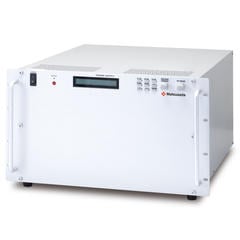
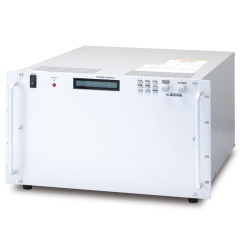
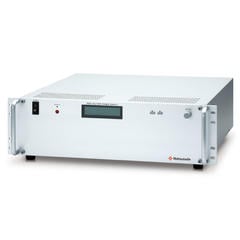
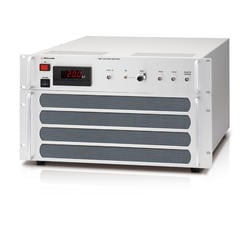
Matsusada Precision offers high-voltage power supplies that can be used for electrostatic lens electrodes, precision constant-current power supplies for electromagnetic lens coils, and high-voltage amplifiers capable of bipolar (positive and negative) output.
Related Technical Articles
- Safety and Usage of High Voltage Power Supply
- HVPS for Lab Analyzers: Key Considerations for Stability and Noise
- Scanning Electron Microscopy (SEM) - Basic knowledge
- SEM Tech Explained, Part 1: Acceleration Voltage and Image Quality
- SEM Tech Explained, Part 2: A Guide to Electron Microscope Lenses
- SEM Tech Explained, Part 3: Principles of SEM Elemental Analysis