


Industrial CT
X-ray CT scanners are broadly categorized into two types: medical and industrial.
- Medical CT scanners
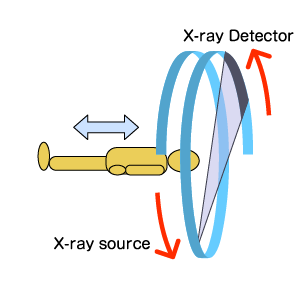
- In medical CT, minimizing patient radiation exposure and motion artifacts is critical.
- To achieve this, the X-ray tube and detector rotate around the patient at high speed. This requires a high X-ray output (high dose rate) for a very short duration to capture images quickly.
- Industrial CT scanners
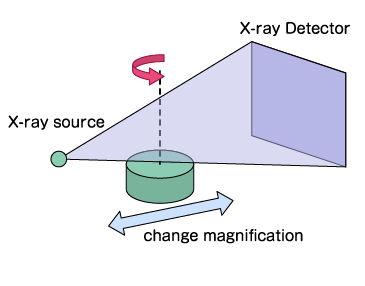
- In industrial applications, the object is typically placed on a rotating turntable while the X-ray tube and detector remain stationary.
- Since exposure time is less constrained than in medical applications, lower dose rates can be used over longer periods. This allows for high-resolution, low-noise imaging, making these systems ideal for non-destructive testing (NDT), defect analysis, and reverse engineering.
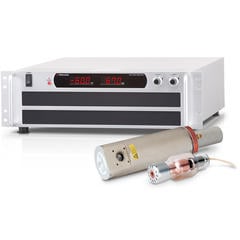
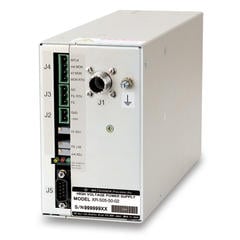
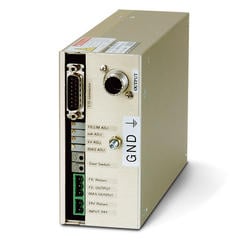
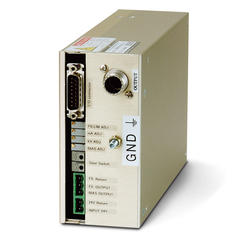
Matsusada Precision offers a wide range of high-voltage power supplies designed specifically for X-ray tubes in industrial CT inspection systems. These power supplies ensure the output stability required for high-resolution imaging.
Recommended products
Related Technical Articles
- Basics and Principles of Computed Tomography (CT)
- How to Acquire High-Quality Computed Tomography (CT) Images - X-ray NDT series (1)
- A Guide to X-ray CT Images: Formats, Viewing, and Applications - X-ray NDT series (2)
- X-ray Image Processing and Automated Inspection - X-ray NDT series (3)
- Non-Destructive Testing: Types and Applications
- What are X-rays? (Basic Knowledge)
- Types of X-ray Tubes and High-voltage Power Supplies
- What is the difference between Radioactivity, Radiation, and Radioactive Materials?
- Understanding Radiation: Effects on the Body and X-ray Safety
- What is Microfocus X-ray Technology? (Basic Knowledge)
- What is X-Ray Fluorescence? (Basic Knowledge)