
What is an RF Amplifier?
An RF (Radio Frequency) amplifier is an electronic device designed to amplify high-frequency signals into high-power output. It is often referred to as an RF power amplifier, RF generator, or microwave power amplifier. These amplifiers are critical components in various industries, particularly for plasma generation in semiconductor manufacturing processes such as etching and sputtering.
RF Amplifier Frequency Ranges
RF amplifiers operate over a wide frequency spectrum, ranging from kilohertz (kHz) to gigahertz (GHz). For many industrial and scientific applications, operation is typically restricted to ISM (Industrial, Scientific, and Medical) bands, such as 13.56 MHz and 2.45 GHz, to comply with international telecommunications regulations.
How does the RF amplifier work?
An RF amplifier's basic components include an oscillator, a DC power supply, transistors, and a matching circuit.
Oscillator
The oscillator generates the frequency of the RF signal. The 13.56 MHz frequency is mainly used in industrial applications.
DC power supply
The DC power supply provides the bias voltage and current to operate the transistors. Variable DC power supplies up to about 100 V are used. The current or power varies from a few hundred watts to several kilowatts or tens of kilowatts, depending on the application.
Transistor
RF power amplifiers typically use transistors as the amplifying element.
The following is a list of commonly used transistor types.
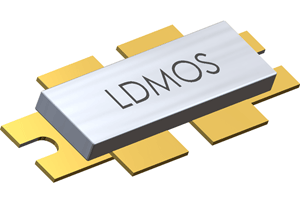
LDMOS (Lateral Diffusion Metal Oxide Semiconductor)
Advantages: High power handling capability and efficiency, suitable for RF applications. It combines the advantages of MOSFET and BJT.
Function: Often used in high-power RF amplifiers and can switch effectively at high frequencies.
- LDMOS device manufacturers
- Ampleon: https://www.ampleon.com/
- NXP Semiconductors: https://www.nxp.com/
- Infineon Technologies: https://www.infineon.com/
- STMicroelectronics: https://www.st.com/
- Integra Technologies: https://www.integratech.com/
- MACOM: https://www.macom.com/
- Wolfspeed (formerly Cree): https://www.wolfspeed.com/
- Qorvo: https://www.qorvo.com/
- Analog Devices: https://www.analog.com/
- Microchip Technology: https://www.microchip.com/
MOSFET (Metal Oxide Semiconductor Field Effect Transistor):
Advantages: fast switching, excellent thermal stability, high efficiency. Often used in applications requiring high-speed switching.
Function: Fast on/off, controls current flow, effectively converts DC voltage to high-frequency AC waveforms.
GaN (Gallium Nitride) Transistors
Advantages: excellent efficiency, high breakdown voltage, very fast switching speed. These properties have made GaN increasingly popular in high-frequency applications.
Function: GaN devices used in state-of-the-art power supplies can support high frequencies (up to several GHz) and provide higher power densities than traditional silicon-based devices.
Matching Network
The matching network is a circuit designed to match the impedance between the RF amplifier and the load, maximizing power transfer efficiency.
Operating Principles
- Signal Flow
- Input Stage: The RF signal is applied to the transistor input (gate).
- Amplification: Transistors convert DC power from the power supply into amplified RF power.
- Output Stage: The amplified signal is transmitted through the output.
- Impedance Matching: Input and output matching networks optimize power transfer to the load.
- Bias Control: A DC bias circuit sets the transistor's operating point for optimal amplification.
- Efficiency and Control
- Modern RF amplifiers achieve high power conversion efficiency, often exceeding 90%, reducing heat generation and cooling requirements. Advanced features include fast auto-matching to respond to load variations and dynamic power management that adjusts the DC supply voltage based on output requirements.
Technical Challenges
- • Thermal Management: High-power operation generates significant heat, requiring effective cooling solutions.
- • Linearity: Maintaining signal linearity while maximizing efficiency is critical for modern modulation schemes.
- • Stability: Preventing unwanted oscillations is essential for reliable operation.
- • Reliability: Semiconductor manufacturing equipment demands continuous, fault-free operation.
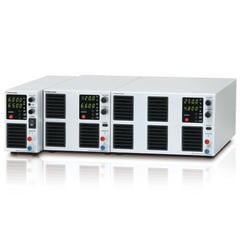
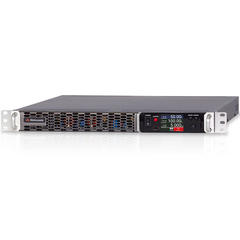
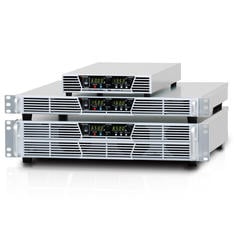
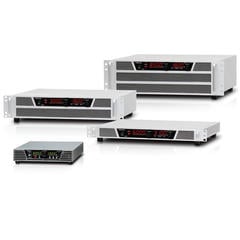
To address these challenges, RF power supply designs are continuously improved through optimized circuit design and digital control. Matsusada Precision leverages extensive experience as an equipment manufacturer to develop highly stable DC power supplies optimized for RF applications.
What are the applications of RF amplifiers?
RF amplifiers are used in the fields of science, industry, telecommunications, and medicine.
- Plasma generator for semiconductor manufacturing equipment
- Magnetic resonance imaging (MRI systems)
- CO2 lasers
- Industrial heating, welding, and defrosting
- Synchrotron (Particle accelerators)
- Avionics and radar systems (e.g., L-band, S-band, and UHF radar)
- Broadcast
- Power amplifier for mobile base stations
- FM & TV broadcasting
- HF & VHF communication
- Related Terms:
-
- RF amplifier
- RF power amplifier
- high-frequency power supply
- microwave power amplifier
- Plasma
- LDMOS
- Langmuir probe