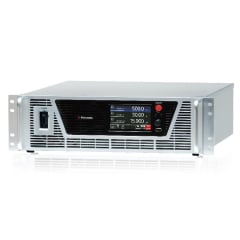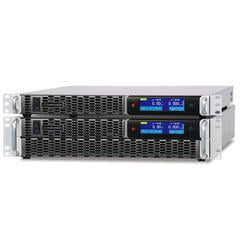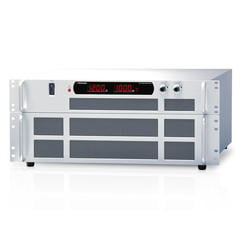

Double pulse testing is a standard technique used to characterize the switching performance of power semiconductor devices, such as SiC MOSFETs and IGBTs. By applying two distinct pulses with a short interval, engineers can evaluate the device's turn-on and turn-off behavior under controlled current conditions. This testing is essential for optimizing the efficiency and reliability of power electronics systems.

Purpose of the test
The primary objectives of the test include:
- Measuring switching parameters, including turn-on (ton) and turn-off (toff) times.
- Quantifying switching losses (Turn-on Energy: Eon, Turn-off Energy: Eoff).
- Assessing reverse recovery characteristics (Reverse Recovery Charge: Qrr) of body diodes.
- Observing voltage and current overshoot during switching events.
- Analyzing device behavior under various voltage and current operating conditions.
Double pulse test setup
A standard test setup requires a DC power supply (to charge the DC link capacitor), a pulse generator, and an oscilloscope. Inductive loads and high-bandwidth probes are also essential components. The circuit typically utilizes a half-bridge configuration consisting of two power devices: one acts as the Device Under Test (DUT), while the other provides a freewheeling path. A precisely controlled gate driver circuit is crucial for accurate signal application.
Double pulse test procedure
- First Pulse: A pulse is applied to the gate to build up the target current in the inductor.
- Turn-off: The device is turned off. Turn-off characteristics and energy loss (Eoff) are measured during this transition.
- Second Pulse: A second pulse is applied. Turn-on characteristics (Eon) and reverse recovery effects (Qrr) are measured at the rising edge of this pulse.
By adjusting the width of the first pulse, switching characteristics can be evaluated at different load current levels.
Main Measurements
During the double pulse test, the following key parameters are monitored:
- Drain-Source Voltage (VDS) or Collector-Emitter Voltage (VCE)
- Drain Current (ID) or Collector Current (IC)
- Gate-Source Voltage (VGS) or Gate-Emitter Voltage (VGE)
From the captured waveforms, engineers can calculate:
- Switching times (turn-on and turn-off delay, rise/fall times)
- Switching energy losses (Eon, Eoff)
- Voltage and current slew rates (dv/dt and di/dt)
- Reverse recovery parameters (Irrm, Qrr, trr)
Applications
- Characterization of wide-bandgap semiconductors (SiC, GaN) and silicon devices.
- Optimization of gate drive circuits and parameters.
- Evaluation of EMI (Electromagnetic Interference) performance.
- Validation of SPICE models for circuit simulation.
The double pulse test provides comprehensive data on switching behavior, enabling the design of high-efficiency and robust power converters.
Considerations for Accurate Double Pulse Testing
Obtaining precise data through double pulse testing is critical for maximizing power device performance. Accurate results depend on a well-designed evaluation board, high-performance measurement instruments, and a controlled testing environment. To ensure reliability and efficiency in application development, consider the following:
Considerations for accurate test results
- Probe Selection: Use high-bandwidth, isolated, or differential probes suitable for high-side measurements.
- Parasitic Inductance: Minimize stray inductance in the layout to reduce voltage spikes and ringing.
- Thermal Management: Account for self-heating effects, especially during high-current or high-voltage testing.
- Standard Compliance: Refer to relevant standards (e.g., JEDEC, IEC) for consistent parameter definitions and measurement methods.
- Related Terms:
-
- double pulse test
- power semiconductor
- switching characteristics
- turn-on parameters
- turn-off parameters
- reverse recovery characteristics