


Types of Motors Used in EVs
Governments in Europe, the United States, and China are actively promoting the transition from internal combustion engines to electric vehicles (EVs). In Japan, major automakers are also accelerating EV development. Unlike gasoline vehicles, EVs are powered by a battery and an electric motor. The type of motor used varies by manufacturer, with continuous improvements being made to enhance efficiency and performance.
Motors are generally categorized into DC motors and AC motors. For EV traction, reliability and efficiency are paramount. Here, we outline the characteristics of the motor types often discussed in motor theory and their relevance to EVs.
Brushed DC Motors
Brushed DC motors use coils for the rotor and permanent magnets for the stator (Fig. 1). They rotate as long as current is supplied, making the system simple and inexpensive. However, they rely on physical brushes and a commutator to switch current. This contact causes friction, electrical noise, and wear, requiring regular maintenance. Consequently, they are rarely used for the main traction of modern EVs.
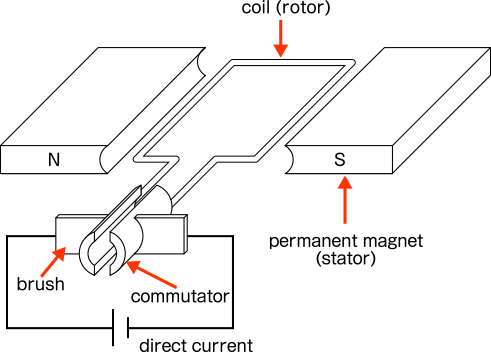
Fig. 1 Schematic of a brushed DC motor
Stepper Motors (Comparison of Principles)
A stepper motor operates by switching electromagnets in the stator to rotate a permanent magnet rotor in fixed steps (Fig. 2). While excellent for precise positioning in industrial automation, stepper motors generally lack the continuous high torque and efficiency required for propelling a vehicle. They serve here primarily to illustrate the principle of electronic commutation--controlling rotation without physical brushes.
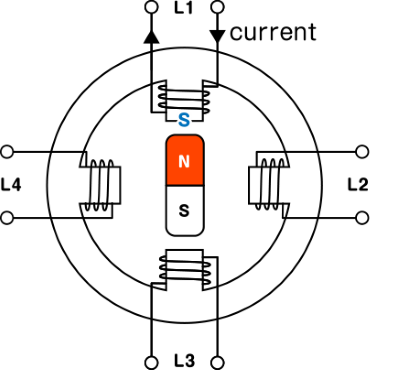
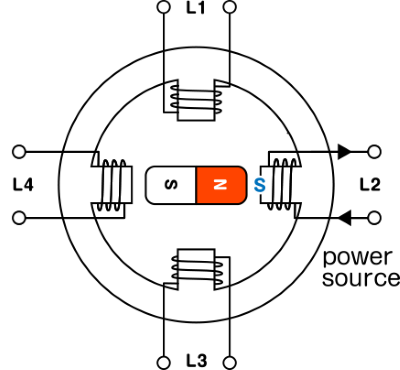
Fig. 2 Working principle of a stepper motor:
(a) first electromagnet switched on;
(b) first electromagnet switched off and second electromagnet switched on
As the rotor approaches the electromagnet in response to the magnetic poles of the rotor, the electromagnet is switched off and the electromagnet ahead of the rotation is turned on. Repeating this, the rotor keeps rotating, and the rotation speed is controlled. However, many electromagnets are required for smooth control, and switching control becomes difficult.
Brushless Motors
To overcome the limitations of brushed motors and the torque constraints of stepper motors, EVs utilize Brushless Motors (Synchronous Motors) (Fig. 3). These operate on a three-phase AC power supply (converted from the battery's DC via an inverter). The rotor contains permanent magnets, and the stator uses electromagnets.
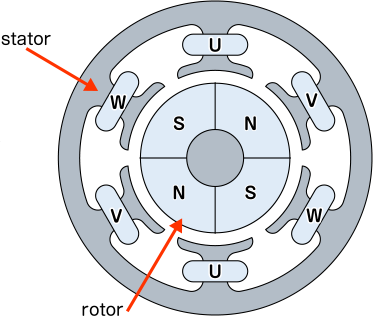
Fig. 3 Schematic of a brushless motor. U: U-phase winding; V: V-phase winding; W: W-phase winding; rotor: magnet
Brushless motors offer high efficiency, low noise, and high durability due to the absence of brushes. However, they require a sophisticated control system. An inverter and ECU (Electronic Control Unit) must precisely control the frequency and current based on the rotor's position and the driver's accelerator input. This complexity is managed by advanced power electronics, allowing for optimal torque and speed control (Fig. 4). Manufacturers are continually increasing the drive voltage to achieve higher torque and rotation speeds.
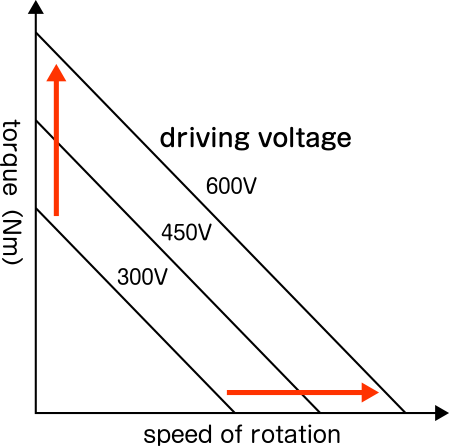
Fig. 4 Relationship between drive voltage and torque
Requirements for EV Power Supplies
Several factors determine the design of EV power systems: voltage, electrical capacity, temperature characteristics, and safety.
Voltage and Battery Configuration
Lithium-ion batteries are the standard for modern EVs. A single lithium-ion cell typically has a nominal voltage of approx. 3.6 V to 3.7 V. These cells are assembled into modules, which are then connected in series and parallel to form a high-voltage battery pack. While older EV architectures operated around 300 V to 400 V, newer high-performance systems are moving toward 800 V to enable faster charging and higher efficiency.
Electrical Capacity and Range
Electrical capacity (kWh) directly impacts the vehicle's cruising range. Early EV models typically featured battery capacities between 20 and 40 kWh. However, recent long-range models often exceed 60 kWh to 100 kWh, significantly extending the driving distance. (Note: We recommend removing the outdated Table 1 listing 2012-2017 models, or replacing it with a graph showing the trend of increasing battery capacity over time.)
Temperature Characteristics
Lithium-ion batteries are sensitive to temperature. Excessive heat during rapid charging or discharging can degrade performance and safety. Conversely, extremely low temperatures (below -30 °C) increase internal resistance, reducing output. Therefore, thermal management systems are critical.
Safety Testing
Safety is paramount. Batteries contain electrolytes and high-voltage circuits that must be isolated from the chassis. Rigorous testing is required to ensure no leakage occurs even during a collision. Since EVs utilize a mix of high-voltage traction systems and low-voltage (12 V) auxiliary components, testing equipment must cover a wide range of voltages and load conditions.
Table 1 Electric capacities of various EV models
| Automobile manufacturer | Type of vehicle | Type | EV driving mode (JC08) |
EV driving mode (EPA) |
Capacity of a battery | Quick charge |
|---|---|---|---|---|---|---|
| BMW | i3 (94 Ah) | BEV | 390 | 182 | 33 | Yes |
| Honda | FitEV (end of life at 03/2016) |
BEV | 225 | 131 | 20 | Yes |
| Mitsubishi | i-MiEV X | BEV | 180 | 99 | 16 | Yes |
| Mitsubishi | i-MiEV M | BEV | 120 | 66 (undisclosed) |
10.5 | Yes |
| Nissan | Leaf, New Model (40 kWh) | BEV | 400 | 241 | 40 | Yes |
| Nissan | Leaf, Old Model (30 kWh) | BEV | 280 | 171 | 30 | Yes |
| Tesla | Model S 75 | BEV | (undisclosed) | 398.4 | 75 | Yes |
| Tesla | Model S P100D | BEV | (undisclosed) | 504 | 100 | Yes |
| Tesla | Model X 75D | BEV | (undisclosed) | 380.8 | 75 | Yes |
| Tesla | Model X P100D | BEV | (undisclosed) | 462.4 | 100 | Yes |
| Volkswagen | e-Golf | BEV | 301 | 201 | 35.8 | Yes |
Third, lithium-ion batteries have specific electrical characteristics based on temperature. The temperature rises due to charge and discharge, and the output voltage decreases when the temperature exceeds 70 ℃. Moreover, the internal resistance increases when the temperature falls below -30 ℃.
Finally, there are also safety concerns. Liquid leakage may occur due to the use of electrolytes. Precautionary measures against leaks in the module are critical to prevent problems while driving.
In addition, because the vehicle needs to be safe in the event of a collision, a level that does not leak even in normal conditions is required, resulting in increased weight and cost of the vehicle. The voltage required in determining if there is a leakage is high in comparison to the 100 V required for household use. The 12 V battery installed in a gasoline vehicle makes the comparison with EV difficult. EV is a collective entity of parts of various voltages ranging from motors that require high voltage, and those requiring low voltage. Consequently, safety tests should also be performed with power supplies that support various voltages.
Recommended products
Engineers working on traction inverters and batteries for EV motors select Matsusada Precision's power supply equipment for evaluation and testing.


Reference (Japanese site)
- Japanese source page 「電池業界が熱い! EV用モーターの電源電圧」
(https://www.matsusada.co.jp/column/ev-power.html) - 電気自動車に使われるモーターの種類と仕組み
(https://allabout.co.jp/gm/gc/423947/) - 世界が注目するEVモーターの高効率化原理について考えてみよう
(https://edn.itmedia.co.jp/edn/articles/1805/22/news006.html) - いまさら聞けない 電装部品入門(11)
(https://monoist.itmedia.co.jp/mn/articles/1401/16/news007.html) - ステッピングモーターの基礎
(https://www.orientalmotor.co.jp/tech/webseminar/stkiso_2_1_1/) - スピードコントロールモーター/ブラシレスモーター
(https://www.orientalmotor.co.jp/tech/reference/brushless01/) - 日産リーフ分解調査(その2)
(https://www.marklines.com/ja/report_all/rep1104_201209) - 電気自動車のメーカー別一覧
(https://blog.evsmart.net/electric-vehicles/ev-phev-list/) - EVの課題克服?リチウムイオン電池の後釜
(https://business.nikkei.com/atcl/report/15/226265/051700123/)