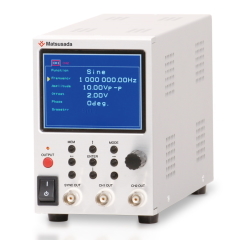

A bipolar power supply is a unit capable of producing both positive and negative voltage outputs. This article explores bipolar power supplies as four-quadrant power supplies that function as both a source (power supply) and a sink (load) in positive and negative polarities. It also discusses testing electrical components-an increasingly common application-with practical examples.
Whether you want to understand the basics of bipolar power supplies or plan to implement them in your work, this comprehensive guide provides valuable insights.
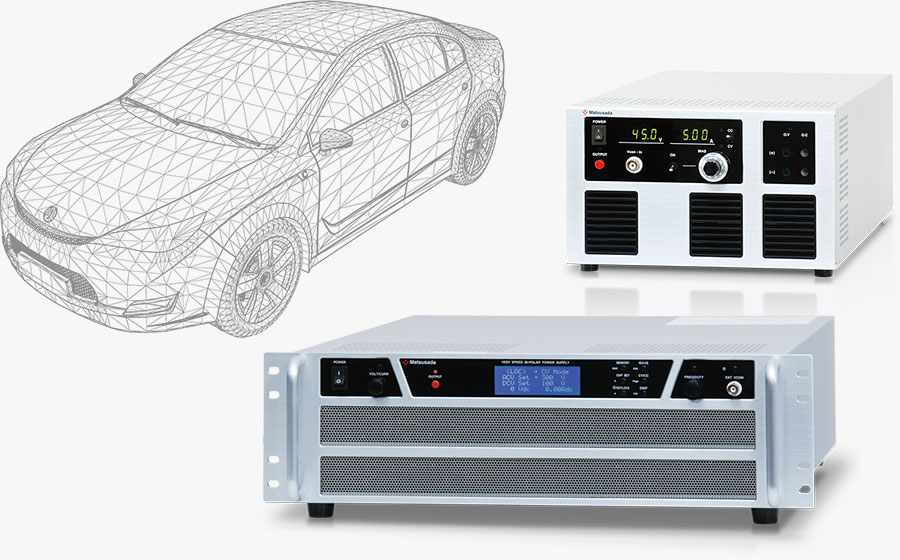
Basics of Bipolar Power Supplies
What is a Bipolar Power Supply?
Standard utility power (AC) often contains noise and fluctuations, requiring conversion into stable DC voltage for electronic device testing. While conventional DC power supplies provide stable output, they are typically limited to a single polarity.
A bipolar power supply (also known as a bipolar amplifier or four-quadrant power supply) is a versatile unit capable of outputting both positive and negative voltages. Crucially, it functions as both a source (supplying power) and a sink (absorbing power/electronic load). This capability allows it to operate across all four quadrants of voltage and current, making it an all-in-one solution for complex testing scenarios.
Key Features
- High-Speed Operation: Capable of rapid response, making them ideal for transient response testing and power fluctuation simulations.
- Versatility: Combines the functions of a DC power supply and an electronic load, reducing the need for multiple pieces of equipment.
- Considerations: Due to their complex circuitry and four-quadrant capability, bipolar power supplies typically involve a higher initial investment compared to standard unipolar power supplies.
Basic Structure
A key distinguishing feature of bipolar power supplies is their ability to generate both positive and negative voltages using two separate internal power systems.
The overall architecture consists of three main components: the output circuit, the protection circuit, and the cooling mechanism.
Output Circuit
The output circuit is the core component responsible for generating and delivering the required electrical power. This circuit performs several critical functions: it converts incoming AC power from wall outlets into the desired form, be it DC or a specific frequency or voltage. In addition, it filters out noise in the utility power and stabilizes current fluctuations caused by connected devices, ensuring consistent power delivery.
Most bipolar power supplies use either linear or switching regulators in their output circuits to perform these functions.
Protection Circuit
Bipolar power supplies incorporate protection circuits to guard against overvoltage, overcurrent, and short circuits. These protective features are essential because bipolar power supplies often handle high voltages and currents and are frequently used for testing various electronic devices that may exhibit unexpected behavior. The protection circuits act as critical safety measures, preventing damage to connected equipment and reducing the risk of fire in case of malfunction.
Cooling Mechanism
The process of voltage conversion and frequency modification in the output circuit generates heat. Excessive heating of the power supply can damage the unit and create unsafe operating conditions. To address this thermal challenge, bipolar power supplies use essential cooling mechanisms, such as forced cooling with fans and heat dissipation through heat sinks. These thermal management systems are crucial for maintaining the safe and reliable operation of the power supply.
Voltage Generation Methods
Bipolar power supplies use either linear regulators or switching regulators to generate the desired voltage output.
Linear Amplifier Method
The linear method uses transistors operating in their active region to regulate output. While generally less efficient than switching designs, linear bipolar power supplies offer superior performance in terms of output noise and transient response. They provide exceptionally clean, stable voltage with minimal ripple, making them the ideal choice for precision testing applications requiring high signal fidelity.
Switching Power Supply Method
The switching power supply method regulates voltage through high-speed transistor switching operations. Unlike linear power supplies, this method offers greater versatility, capable of not only reducing voltage but also boosting and inverting it. This makes switching power supplies essential for applications that require voltages higher than standard 100V or 200V levels.
Due to their superior efficiency and ability to handle high power outputs, switching power supplies have become the predominant choice for bipolar power supply designs. However, this method does have one notable drawback: the switching operations inherently generate more electrical noise than linear power supplies.
Two-Quadrant and Four-Quadrant Operation
Power supply outputs are classified into four quadrants based on voltage and current polarity (+/−). Traditional DC power supplies, known as unipolar power supplies, operate only in the first quadrant (positive voltage and current) and the third quadrant (negative voltage and current). In contrast, bipolar power supplies can operate across all four quadrants, enabling both two-quadrant and four-quadrant operations.
Two-Quadrant Operation
In two-quadrant operation, the current flows in a single direction, while the power supply can switch between positive and negative output voltages. This allows operation across the first and fourth quadrants simultaneously. This capability is particularly useful for applications that require straightforward positive and negative voltage supply.
Four-Quadrant Operation
The distinguishing feature of bipolar power supplies is their ability to control both output voltage and current direction. Unlike conventional power supplies, they can handle current flow from the load back to the power supply. This full four-quadrant operation encompasses all quadrants, from the first through the fourth.
This capability is essential for applications such as evaluating motor reverse rotation or energy regeneration systems, where energy flows back from the load to the power supply. Four-quadrant operation is designed for applications that require more sophisticated control compared to two-quadrant operation.
Types of Bipolar Power Supplies
Bipolar power supplies come in several varieties. Here are four main types:
Bipolar Power Supplies with Built-in Signal Sources
These power supplies feature integrated signal generators capable of producing various waveforms. They are particularly valuable for applications that require high-speed, high-level signals, such as ultrasonic motor drives and display testing. This integrated design eliminates the need for external signal sources, allowing for comprehensive testing and evaluation using a single unit.
Bipolar Amplifiers for External Signal Amplification
These units function as high-voltage amplifiers for external input signals. For example, they can amplify a low-voltage signal (e.g., ±10V) to high-voltage levels (e.g., ±10kV). They are designed to faithfully reproduce input waveforms at high voltages, making them essential for driving transducers or modulating high-voltage fields.
High-Voltage Amplifiers for Rapid Signal Processing
These specialized amplifiers are designed to handle high-voltage signals with rapid response times. The key parameter here is the slew rate-the rate of voltage change over time. High slew rates are essential for maintaining signal integrity when dealing with high-voltage signals, as lower rates can result in signal degradation and compromised response times. These units incorporate dedicated high-voltage amplifier modules to ensure optimal response characteristics.
Power Supplies for Piezo Drivers and Electrostatic Chucks
A specific category of bipolar power supplies is designed for piezo drivers and electrostatic chucks. These units excel at providing rapid responses to complex signal patterns, making them ideal for these specialized applications.
Applications of Bipolar Power Supplies
Bipolar power supplies serve diverse applications in both product evaluation and equipment power supply roles. Here are some key applications:
Battery-Powered Device Evaluation
When testing battery-powered devices, bipolar power supplies can accurately simulate battery behavior. They can reproduce various characteristics of battery operation, including voltage decay over time, allowing for comprehensive testing of battery-dependent devices.
Coil and Transformer Testing
Bipolar power supplies play a crucial role in testing coils and transformers by reproducing various electrical input signals needed to thoroughly evaluate these components.
Capacitive Load Testing
For testing capacitors and other capacitive loads, bipolar power supplies provide the flexibility needed for comprehensive evaluations. Since capacitance can vary with frequency and voltage, these power supplies enable testing across different frequencies and voltage levels.
Solar Cell Equipment Testing
With the growing emphasis on environmental sustainability, solar cell technology has seen increasing demand. Testing solar cell equipment often requires high-voltage capability, making bipolar power supplies essential for these evaluations.
Motor Testing
Motors come in various sizes and specifications, requiring versatile testing capabilities. Bipolar power supplies can apply different voltage and current loads to motors and evaluate regenerative current during reverse rotation.
Surface Treatment Applications
Industrial surface treatment processes, such as high-frequency hardening, require high-voltage AC current. Bipolar power supplies provide the necessary power characteristics for these specialized applications.
Automotive Electrical Components Testing
The electrification of vehicles (EVs) and the integration of advanced driver-assistance systems (ADAS) have dramatically increased the complexity of automotive electronics. Components must withstand rigorous power fluctuation tests to ensure safety and reliability. Bipolar power supplies are essential for these evaluations because they can simulate complex battery behaviors, regenerate power, and replicate rapid voltage transients found in vehicle networks.
Standards
The following standards apply to automotive electrical components:
| ISO16750-2 | Environmental conditions and testing specifications for electrical and electronic equipment in road vehicles |
|---|---|
| ISO7637 | Testing standards for electrical disturbance in road vehicles |
| ISO10605 | Standard protocols for electrostatic discharge testing |
| AEC-Q100/Q200 | Automotive industry-specific reliability testing standards for electronic components |
| ISO 26262 | Comprehensive functional safety standards for automotive systems |
| UN/ECE R10 | Electromagnetic compatibility (EMC) standards for vehicles |
|
SAE J1113 Series & ISO 11452 Series |
EMC testing standards for automotive electrical equipment |
| LV124 | German automotive manufacturers' testing specifications for vehicle electrical components |
| LV148 | |
| LV123 | Testing standards for high-voltage automotive electrical components using bi-directional power supplies |
Testing Requirements
The aforementioned standards encompass a variety of tests, including rapid voltage fluctuation and voltage ripple testing. Additional requirements include load interruption testing, voltage limitation evaluation, and offset voltage testing. Standard power supplies often struggle to perform these tests effectively, particularly when testing components with high reactance loads. Bipolar power supplies offer the flexibility needed to conduct these sophisticated evaluations.
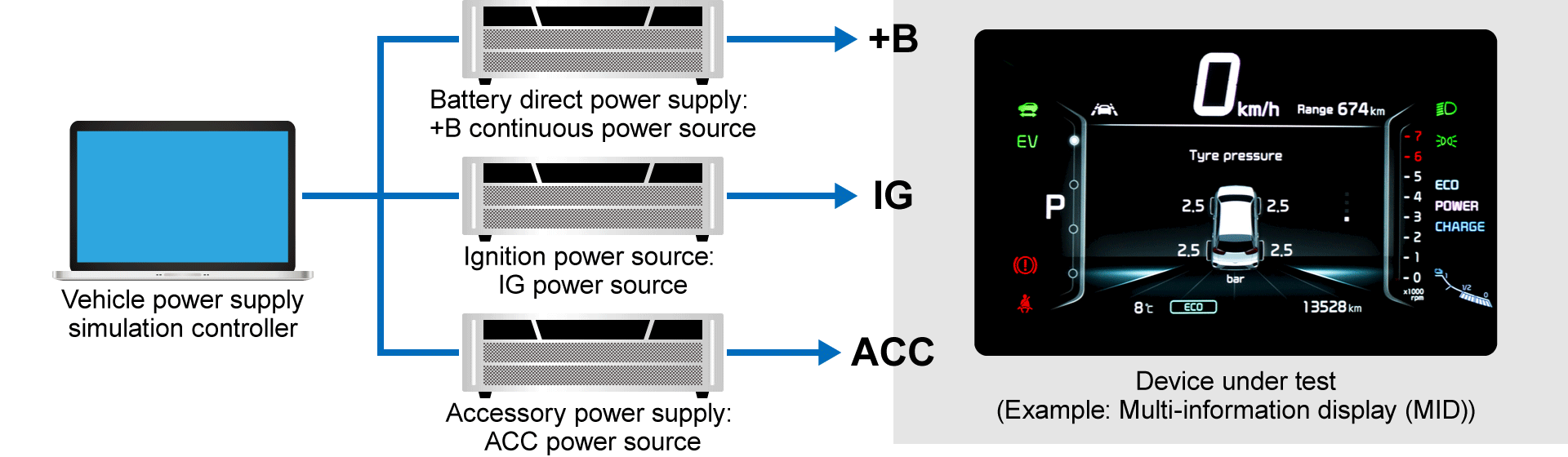
Testing Navigation Systems with Bipolar Power Supplies
Vehicle navigation systems operate on power from the car's battery and related power systems. As previously discussed, multiple electrical components share this power source, with each component operating in complex patterns that create intricate power fluctuations. Bipolar power supplies are used to verify that navigation systems function properly under these conditions and do not generate electrical interference that could affect other vehicle systems.
A typical test system configuration is outlined below.
How to Select the Right Bipolar Power Supply
With various specifications available, consider the following factors to match the power supply to your application:
Voltage and Current Output Range
One of the most crucial factors in selecting a bipolar power supply is its voltage and current output range.
For instance, in Matsusada Precision's product line, output voltage ranges vary significantly-from units offering ±20V-60V to those providing ±0.5kV-1kV. The selection should align precisely with your application's specific requirements.
Response Speed Capabilities
Different applications demand different response speeds. Some applications, such as high-voltage signal testing, require rapid response times, while others, like battery aging simulation tests, can operate with lower response rates. For example, Matsusada Precision offers units with response speeds ranging from DC to 10kHz, and others extending from DC to 1,000kHz.
Thermal Management
Applications involving high-speed switching or continuous sinking of current generate significant heat. It is critical to select a power supply designed with robust thermal management capabilities to ensure long-term reliability. Matsusada Precision's bipolar power supplies are engineered with optimized cooling mechanisms--ranging from forced air to water cooling--to maintain stable operation even under demanding load conditions.
Introduction to Matsusada Precision's Bipolar Power Supplies
Matsusada Precision offers several types of bipolar power supplies for different applications:
Built-in Signal Generator Type Bipolar Power Supply
This model features an integrated signal generator and can serve as a battery simulator for testing battery-powered devices. It can also be used for testing inductive loads such as coils and transformers.
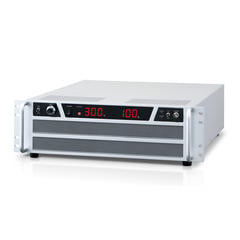
External Input Type Bipolar Power Supply
This model accepts external signal inputs and is suitable for testing capacitive loads like capacitors or for use as a power conditioning system.
Function Generator (External Signal Source)
Function generators connect to external input type bipolar power supplies to generate custom waveforms and test signals.