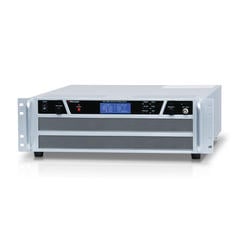

This article covers UPS power delivery methods, system types, and guidance for selecting appropriate energy storage technologies.
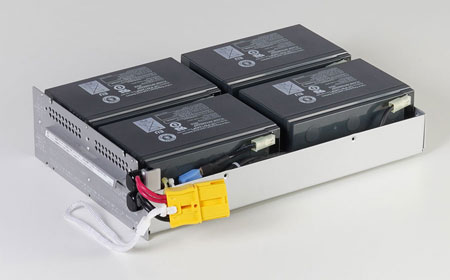
Uninterruptible Power Supply (UPS) Basics
UPS systems are widely used in offices, server rooms, and data centers to protect critical equipment from power outages and electrical anomalies. These units employ various power delivery methods, and selecting the optimal approach depends on the specific application and required power quality standards. The growing adoption of renewable energy has also sparked increased interest in integrating UPS systems with grid-scale battery storage.
Background: The Drive for Power Resilience and Renewable Energy Integration
In recent years, a growing number of companies and municipalities have developed business continuity plans, placing greater emphasis on preparing for power outage risks caused by natural disasters and cyberattacks. At the same time, the expanding use of renewable energy sources-such as solar and wind power, driven by decarbonization goals-has increased demand for energy storage systems that can offset fluctuations in weather-dependent generation. As a result, UPS systems and battery storage have become essential for maintaining a stable power supply.
UPS Power Supply Methods
UPS systems employ several different power delivery methods. This section outlines the mechanisms and characteristics of the most common approaches.
Standby (Offline) Method
In the standby method, equipment receives power directly from the utility supply during normal operation while simultaneously charging the battery. When a power anomaly occurs, the system switches to battery power. This approach offers high efficiency, a compact size, and low cost due to minimal power conversion.
However, this transfer causes a brief interruption lasting several milliseconds, making this method unsuitable for equipment that requires the highest power quality. For typical PCs and network equipment, these millisecond-level interruptions rarely cause operational issues.
Online (Double-Conversion) Method
The online method continuously converts incoming utility power to DC, uses this DC power to charge the battery, and simultaneously converts it back to AC through an inverter to power the connected equipment. Since the power path remains constant even when utility power fails, this method enables seamless power transfer without interruption.
The inverter consistently delivers a stable sine wave, ensuring excellent power quality. This makes it ideal for mission-critical equipment such as servers, network infrastructure, and medical devices, where even a momentary power loss cannot be tolerated.
Line-Interactive Method
The line-interactive method combines features of both standby and online approaches. During normal operation, it provides direct utility power to equipment while incorporating automatic voltage regulation to correct voltage fluctuations. In the event of a complete power failure, it seamlessly switches to battery operation.
This method offers an excellent price-to-performance ratio-more cost-effective than online systems while delivering better voltage regulation than standby systems. It is widely used for small- to medium-scale servers and network equipment. However, like the standby method, brief power interruptions may still occur during the switch to battery power.
Capacity Ranges
UPS capacity should be selected based on the scale and requirements of the equipment being protected. This section outlines the characteristics and applications of different capacity ranges.
Several Hundred VA to Several kVA
UPS systems in the several hundred VA to several kVA range are ideal for protecting small-scale equipment that can be safely shut down during short backup periods. These include desktop computers, laptops, small servers, and network devices. This capacity range typically provides enough backup time for an orderly system shutdown and reliable data protection.
10 kVA to Several Hundred kVA
UPS systems in the 10 kVA to several hundred kVA class serve enterprise-level, mission-critical systems and data centers. They protect essential equipment necessary for business continuity, including large-scale server systems, telecommunications infrastructure, and medical equipment. Given the high availability demands, these systems often feature redundant configurations such as N+1 redundancy and hot-standby capabilities. Most units in this range use online (double-conversion) topology to deliver consistently stable, high-quality power. Installation requires dedicated electrical infrastructure and sufficient facility space.
Types of Energy Storage Technologies
Beyond UPS systems, various energy storage technologies have been developed to ensure a stable power supply. The ideal choice depends on performance requirements and the specific application-ranging from residential to industrial use. This section provides detailed coverage of three leading energy storage technologies, outlining their characteristics and areas of application.
Comparative Summary of Energy Storage Technologies
The following table summarizes the key characteristics of three representative energy storage technologies.
| Energy Storage Technology | Residential Solar-Integrated Systems | Flywheel Energy Storage | Grid-Scale Redox Flow Batteries |
|---|---|---|---|
| Overview | Compact home energy storage systems designed to integrate with solar power generation | Energy storage systems that use kinetic energy from high-speed rotating flywheels | Large-scale systems that store energy through the circulation of electrolytes in charge-discharge cycles |
| Capacity Range | 3-16 kWh | Several kWh to tens of kWh | MWh-class (utility scale) |
| Primary Applications |
|
|
|
| Service Life | 10-15 years | 20+ years | 20+ years |
| Key Features |
|
|
|
Residential Energy Storage Systems (Solar-Integrated)
Residential energy storage systems are compact battery solutions designed primarily for integration with solar power generation. These systems store excess solar energy produced during daylight hours for use at night or during inclement weather, thereby increasing self-consumption rates and reducing electricity costs. During power outages, they serve as backup power sources for essential household appliances. Lithium-ion battery technology dominates this market, with recent trends favoring smaller form factors and lower costs.

Flywheel Energy Storage
Flywheel energy storage technology converts electrical energy into kinetic energy by spinning a rotor (flywheel) at extremely high speeds. Unlike chemical batteries, flywheels can deliver instantaneous high-power output, making them ideal for protecting critical infrastructure such as data centers.
High-efficiency energy storage is achieved through magnetic bearings and vacuum enclosures that reduce friction losses. Key advantages include minimal environmental impact during operation-since no chemical reactions are involved-and exceptionally long cycle life compared to lead-acid or lithium-ion alternatives.
Grid-Scale Redox Flow Batteries
Redox flow batteries operate by circulating liquid electrolytes through electrochemical cells to store and release energy. These large-capacity systems utilize redox reactions of ions, such as vanadium, to achieve MWh-scale energy storage. The tank-based electrolyte storage design enables independent scaling of power capacity and energy storage, allowing for easy capacity expansion.
Water-based electrolytes offer excellent safety characteristics with low fire risk. Additionally, minimal compositional changes in the electrodes and electrolytes during charge-discharge cycles result in limited degradation, delivering long service life and low lifecycle costs. These features make redox flow batteries particularly well-suited for renewable energy integration, grid stabilization, and large-scale energy storage applications.
How to Select an Appropriate Energy Storage System
Selecting the right energy storage system requires a comprehensive evaluation that considers not only cost but also the operating environment and potential for future expansion. The following outlines key factors to consider during the selection process.
Energy Capacity (kWh, MWh)
When determining UPS storage capacity, start by calculating the total power consumption (W or VA) of the equipment that requires backup protection. Then, define the necessary backup duration and load-leveling period.
Storage capacity can be estimated by multiplying load power by the required backup time. For example, backing up a 50W load for one hour requires a minimum of 50Wh of energy capacity. While grid-scale storage systems may require MWh-class capacities, small-scale UPS applications often need only a few kWh.
Power Output (kW, MW)
UPS output sizing should account for actual equipment usage patterns. Multiple devices rarely operate simultaneously at maximum load, so real-world power consumption typically falls below the simple arithmetic sum of individual ratings.
However, computers and peripherals often draw about twice their rated power during startup sequences. Output sizing should allow adequate headroom to handle these instantaneous demands. It's also important to consider peak power needs when multiple devices run at maximum load concurrently.
Discharge Duration
Discharge duration requirements vary depending on the application. For data protection and equipment shutdown during outages (typically seconds to 10 minutes), compact UPS systems or small-capacity lithium-ion storage solutions are ideal due to their high power density, which enables rapid delivery of substantial power.
For residential self-sufficiency (lasting several hours), 5-15 kWh lithium-ion home battery systems are common, supporting nighttime usage and short-term outages. For grid regulation (ranging from hours to days), redox flow batteries are well-suited, as their power output and capacity can be scaled independently.
Response Time
Response time refers to the interval between power anomaly detection and energy storage system activation. Applications requiring uninterrupted power-such as servers, data centers, and medical equipment-demand online (double-conversion) UPS systems that eliminate transfer delays. These systems continuously route utility power through the battery path, avoiding interruptions during switching.
Conversely, typical office and network equipment can tolerate millisecond-level interruptions, making cost-effective line-interactive or standby systems sufficient. Clearly defining response time requirements supports a balanced approach to performance and cost in system selection.
Cycle Life
Cycle life indicates how many complete charge-discharge cycles a battery can perform before reaching end-of-life. The required cycle count should be estimated based on usage frequency and expected service life. Residential energy storage systems typically cycle once daily. For batteries designed for a 10-15 year service life, approximately 3,650-5,475 cycles (365 days × 10-15 years) are needed, making batteries rated for 6,000+ cycles appropriate.
Industrial applications in factories and data centers involve more demanding conditions, with power balancing and backup requirements potentially causing multiple cycles per day. These scenarios benefit from high-cycle-life technologies like lithium-ion or redox flow batteries. When frequent cycling is expected, selecting batteries with extended cycle life is essential for long-term reliability.
Power Supplies and Electronic Loads Supporting Development and Quality Assurance
Accurate performance evaluation of UPS and energy storage systems requires comprehensive testing under diverse power supply environments and load conditions. This section outlines the types and characteristics of power and load equipment essential for UPS evaluation.
Bidirectional DC Power Supplies
Bidirectional DC power supplies can both source and sink power, making them versatile test instruments for in-depth evaluation. These systems enable precise assessment of UPS battery characteristics, including charge-discharge behavior, capacity, and response times, allowing engineers to predict long-term operational performance. Additionally, they can simulate battery degradation, helping to predict performance changes across the UPS lifecycle and facilitating product comparisons under realistic operating conditions.
AC Power Sources
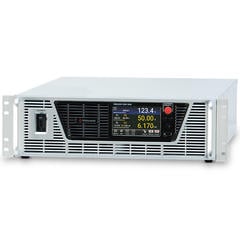
AC power sources are high-precision instruments capable of flexible voltage, frequency, and waveform configuration. These test instruments replicate various commercial power conditions, making them invaluable for UPS performance evaluation. They can simulate real-world power environments, including voltage fluctuations (overvoltage/undervoltage) and frequency variations. Particularly important are instantaneous voltage sag and momentary outage tests, which allow precise assessment of UPS response to brief power disturbances ranging from milliseconds to seconds.
Electronic Loads
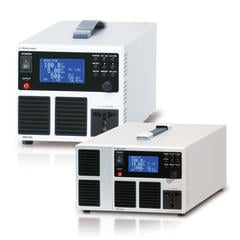
Electronic loads are essential for evaluating the output characteristics of UPS and energy storage systems by replicating actual load conditions. These instruments can simulate various load profiles, including constant current, constant voltage, constant power, and constant resistance modes. Dynamic load testing assesses UPS response and voltage stability under sudden load variations. Battery discharge testing measures capacity and backup duration while maintaining consistent discharge conditions. By reproducing diverse load patterns, engineers can verify performance under conditions that closely resemble real-world environments, such as office equipment and data center applications.
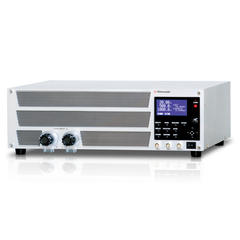
Bipolar Power Supplies
Bipolar power supplies are high-speed response instruments capable of generating both positive and negative voltage outputs. Their ±voltage capability and rapid response characteristics enable a thorough evaluation of UPS inverter circuits. These instruments can precisely verify how UPS systems respond to input voltage variations and assess output stability under dynamic conditions. For testing internal power control circuits, bipolar power supplies can rapidly reproduce voltage fluctuations to evaluate transient response and protection function operation.