
What is Mass spectrometry?
Mass Spectrometry (MS) is a powerful analytical technique used to determine the composition of a sample by measuring the mass-to-charge ratio (m/z) of its ions. This process allows for the identification and quantification of specific atoms and molecules. To perform mass spectrometry, the sample must first be ionized, after which the ions are separated and detected. Various ionization and mass separation methods exist, selected based on the sample's state (solid, liquid, or gas), composition (organic or inorganic), and the specific analytical goals. Due to its high sensitivity and versatility, MS is widely used in pharmaceuticals, environmental analysis, proteomics, and other advanced fields.
Mass Spectrometry Instruments
A mass spectrometer consists of three main components: an ion source, which ionizes the sample; a mass analyzer, which separates the resulting ions based on their mass-to-charge ratio (m/z); and a detector, which measures the abundance of the separated ions.
Mass spectrometry includes gas chromatography-mass spectrometry (GC-MS), which uses gas chromatography (GC) for sample introduction. Other types include liquid chromatography-mass spectrometry (LC-MS), which uses liquid chromatography (LC), and inductively coupled plasma mass spectrometry (ICP-MS), which uses an inductively coupled plasma source.
Ionization section
The ionization section, also referred to as the ion source, includes the following ionization methods.
- Electron ionization (EI)
- Chemical ionization (CI)
- Atmospheric pressure ionization (API)
- Electrospray ionization (ESI)
- Atmospheric pressure chemical ionization (APCI)
- Matrix-assisted laser desorption ionization (MALDI)
- Secondary Ion Mass Spectrometry (SIMS)
The use of each ionization method is limited by whether the compound is to be measured as an organic or inorganic compound and the form of the object to be measured: solid, liquid, or gas.
Mass analyzer section
The mass analyzer separates ions according to their mass-to-charge ratio (m/z) using electric and/or magnetic fields. While lens voltages are crucial for focusing and guiding the ion beam, the separation principle depends on the analyzer type (e.g., ion trajectory stability in a quadrupole or flight time in a TOF). Common mass analyzers include:
- Quadrupole Mass Analyzer (QMS)
- Double-focusing Mass Spectrometer (Sector MS)
- Time-of-Flight Mass Spectrometer (TOF-MS)
- Quadrupole Ion Trap (QIT)
- Fourier Transform Ion Cyclotron Resonance (FT-ICR-MS)
Ion Detection Section
The ion detection section detects specific ions separated in the mass separation section. A mass spectrum--a plot of relative ion abundance versus m/z--is generated. In scanning instruments (like quadrupoles), this is achieved by systematically varying the electric or magnetic fields to allow ions of a specific m/z to reach the detector at any given time. In other instruments, like TOF analyzers, a full spectrum is acquired from each ionization event without scanning.
The following detectors are used in the mass spectrometer
- Microchannel Plate (MCP)
- Electron multiplier tube (EM tube)
- Secondary electron multiplier (Channel Electron Multiplier CMT)
The combination of the ionization section, analyzer section, and sample introduction section is called Q-TOF, MALDI-TOF, LC-TOF, GC-TOF, and other instruments. There are also instruments such as MS/MS in which two mass spectrometers are connected in series with a collision cell.
Precision Power Supplies for Mass Spectrometry
Mass spectrometers utilize various combinations of ion sources and analyzers, each demanding specific power characteristics. To ensure high analytical accuracy, the power supplies must deliver exceptional stability and ultra-low noise. The high-voltage power supplies used in the mass analyzer section, in particular, are critical for precise ion separation and detection.
High-Voltage Solutions for Mass Spectrometry
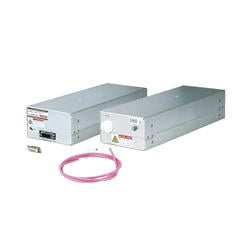
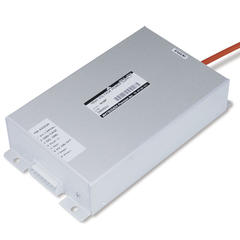
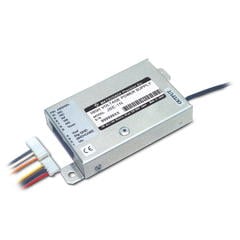
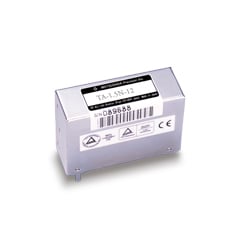
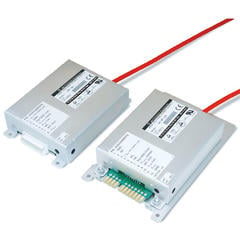
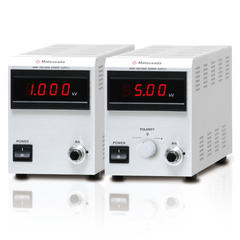
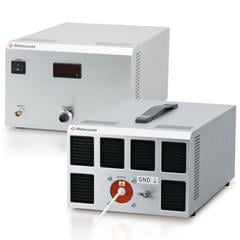
Matsusada Precision offers a comprehensive range of power supplies tailored to the stringent requirements of mass spectrometry. Our high-voltage modules are engineered for key components, including pushers, reflectors, tube biases, extractors, detectors, lenses, ion traps, and accelerators.
Product Lineup Examples
We offer standard and custom high-voltage configurations to meet your specific design needs. Please contact us for custom specifications.
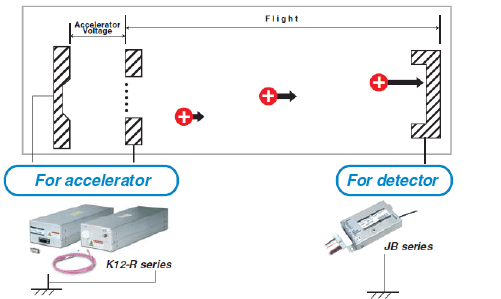
| Application | Series | Feature |
|---|---|---|
| For ion accelerator | K12-R series |
|
| KAS-R series |
|
|
| KA series |
|
|
| For detectors such as EM or MCP | JB series |
|
| TA series |
|
- Related Terms:
-
- ionization
- thermionic electron
- tunneling effect
- magnetic field
- detector
- accelerator mass spectrometer
- Time of flight mass spectrometry (TOF)
- quadrupole mass spectrometers