


- Baggage Inspection
- Baggage screening is performed to prevent dangerous items--such as knives, firearms, chemicals, and other contraband--from being brought into secure areas like airports and train stations. Common screening methods include metal detectors, X-ray scanners, and liquid inspection systems.
- Baggage Inspection by X-Ray
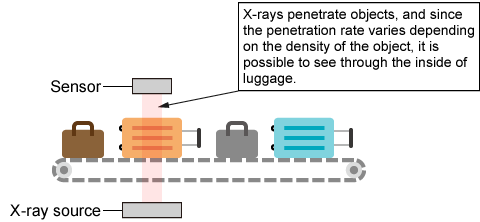
- X-rays possess the ability to penetrate objects, with the degree of transmission depending on the object's density. This property allows inspection systems to create images of the interior of luggage. Consequently, X-ray inspection equipment can visualize contents without opening the baggage, detecting dangerous objects such as weapons and plastic explosives.
- Metal Detectors
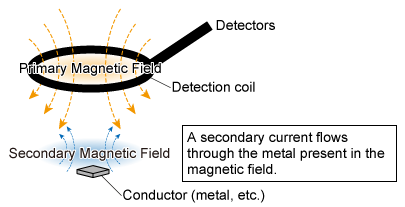
- Metal detectors operate on the principle of electromagnetic induction. When a coil carrying an electric current approaches a metal object, it induces a secondary magnetic field within the metal. The detector senses this secondary field to identify the presence of metal.
- Liquid Inspection
- Near-infrared light is utilized to inspect liquids inside containers. Since different liquids absorb light at specific wavelengths, analyzing the spectrum of the transmitted light enables the identification of substances, including alcohol and other flammable liquids.
Baggage Inspection by X-Ray
How Metal Detectors Work
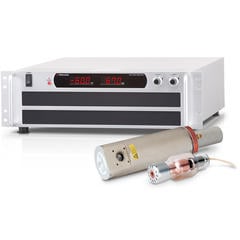
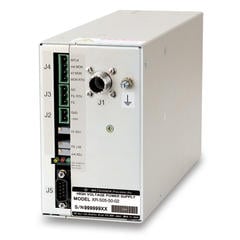
Matsusada Precision offers a wide range of products, including X-ray sources for baggage inspection and compact power supplies designed to drive metal detectors and liquid inspection equipment.
- Related Terms:
-
- baggage inspection
- cargo screening
- explosive detection systems (EDS)
- metal detector
- X-ray
- liquid
- hazardous material
- medicine
- knife
- coil
- electromagnetic induction
Recommended products



Related Technical Articles
- Non-Destructive Testing: Types and Applications
- What are X-rays? (Basic Knowledge)
- Principles of Radiography
- Types of X-ray Tubes and High-voltage Power Supplies
- Safe Operation of X-ray Inspection Systems
- What is the difference between Radioactivity, Radiation, and Radioactive Materials?
- Understanding Radiation: Effects on the Body and X-ray Safety