


Principles of the Three Major Approaches and Supporting Measurement & Power Technologies
The energy source that keeps the Sun shining is "nuclear fusion." On Earth, nuclear fusion power generation is expected to become a next-generation clean energy technology that extracts enormous amounts of energy through the D-T reaction, in which deuterium (D) and tritium (T) fuse together: D + T → 4He + n + 17.6 MeV Because it can significantly reduce long-lived high-level radioactive waste and utilizes fuel resources that exist almost inexhaustibly in seawater, nuclear fusion is often referred to as "a sun on Earth."
To initiate fusion reactions, the fuel must be heated into an ultra-high-temperature plasma reaching 100 million degrees Celsius, and confined at high density for a certain period of time. Various approaches are currently being researched around the world, but this article focuses on the three representative methods: the tokamak type, helical type, and laser fusion type.
In particular, this article takes an in-depth look at two critically important core technologies that usually receive less attention: the "measurement methods and diagnostic instruments" used to precisely monitor plasma behavior at the heart of fusion reactors, and the "power supply technologies" that drive these massive systems and support plasma diagnostics behind the scenes.
(For the differences between fusion power generation and conventional nuclear fission power generation, please refer to the technical column " The Difference Between Nuclear Fusion and Fission Power")
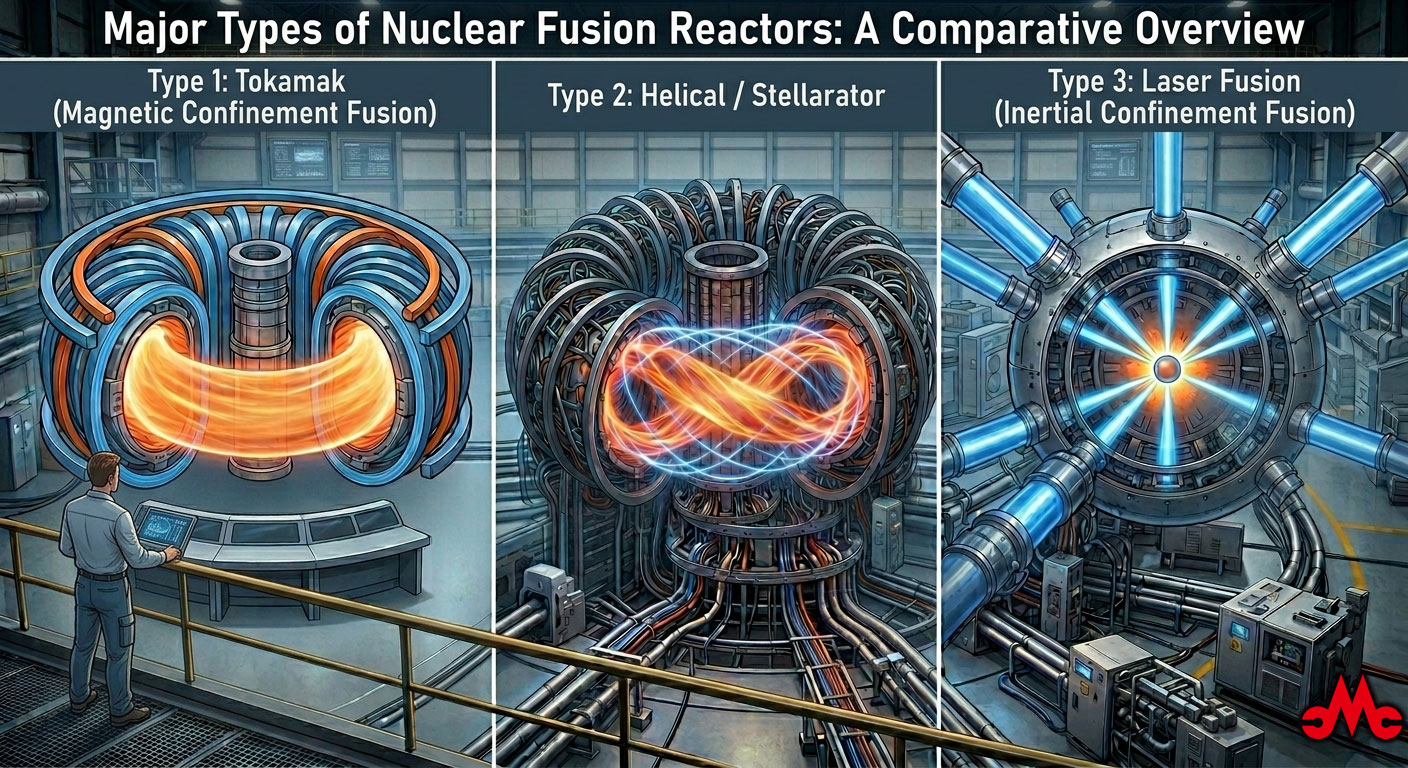
Type 1: Tokamak (Magnetic Confinement Fusion)
Principles of Tokamak-Type Nuclear Fusion Power Generation
The tokamak is the most extensively researched and developed representative of the magnetic confinement fusion approach, and it has been adopted for the International Thermonuclear Experimental Reactor (ITER).
A toroidal magnetic field is generated by passing current through coils arranged around a toroidal (doughnut-shaped) vacuum vessel called a torus. In addition, a large current flowing through the plasma itself generates a poloidal magnetic field. By combining these two magnetic fields, a powerful helical magnetic cage is formed to confine the ultra-high-temperature plasma.
One of the most critical components in tokamak operation is the divertor. The divertor functions as an "exhaust outlet" that removes helium ash generated by fusion reactions and metallic impurities sputtered from the reactor wall. By controlling the magnetic field, high-temperature plasma is intentionally separated and guided toward the divertor plates, thereby mitigating excessive heat concentration.
Because the divertor is exposed to extreme thermal loads reaching several thousand degrees Celsius - the harshest environment inside the reactor - next-generation fusion reactors employ high-melting-point tungsten as a plasma-facing material, along with advanced cooling structures that circulate coolant water at high speed.
Measurement Methods and Diagnostic Instruments for Tokamak Fusion Reactors
Faraday rotation interferometer systems are used to precisely measure the plasma's poloidal magnetic field and electron density. These systems detect phase shifts and polarization rotation (Faraday effect) in light transmitted through the plasma.
This system uses far-infrared (FIR) lasers that emit submillimeter-wave radiation in the several-hundred-micrometer wavelength range. To optically pump the laser medium gas (such as 13CH3OH high-power and highly stable carbon dioxide (CO2) lasers operating at wavelengths such as 10.6 μm and 9.6 μm are essential.
To accurately reconstruct electron density distributions, heterodyne interferometers using two FIR lasers with different oscillation frequencies are commonly employed.
However, this technology involves severe technical challenges. Since the molecular absorption lines of FIR lasers are extremely narrow, even a frequency fluctuation of only a few MHz in the CO2 laser can significantly reduce output power. Therefore, stabilization of the pump offset frequency through resonator length control using piezoelectric elements is indispensable.
In addition, advanced optical techniques are employed to suppress backtalk (optical feedback) caused by interference between the resonators of the CO2 laser and the FIR laser, such as intentionally introducing the excitation beam at an oblique angle.
Langmuir Probes for Direct Measurement of Edge Plasma
While non-contact methods such as lasers are used to measure the plasma core, "Langmuir probes," which directly insert electrodes into the plasma, are widely used for measurements in peripheral regions such as the divertor area near the reactor wall.
These probes cannot be inserted into the plasma core exceeding 100 million degrees Celsius because they would melt under the intense heat. However, they are highly reliable and fundamental diagnostic tools for measuring electron temperature and electron density in plasma leaking toward the reactor wall.
By combining the previously mentioned multi-grid electrodes (for ion measurements) with Langmuir probes (for electron measurements), researchers can obtain critical data used to accurately predict severe heat loads on reactor walls and ensure reactor safety.
Here as well, high-speed, low-noise bias power supplies play an essential role in accurately detecting extremely small currents.
Power Supplies for Tokamak Fusion Reactors
One of the most notable power systems in tokamak reactors is the Neutral Beam Injection (NBI) system used for intense plasma heating and sustained operation
NBI systems accelerate positively charged ions and then pass them through a neutralizer cell, converting them into electrically neutral high-energy beams that are unaffected by magnetic fields and can penetrate deep into the plasma core. NBI systems also contribute to stabilizing tokamak operation by generating non-inductive current drive.
There are two primary types of NBI systems:
- Positive-Ion NBI (P-NBI): Suitable for relatively low-energy injection with high acceleration efficiency, primarily for plasma heating.
- Negative-Ion NBI (N-NBI): Offers higher neutralization efficiency at high energies than positive-ion systems, enabling deeper penetration into the plasma core of large tokamaks and achieving efficient heating and current drive.
Driving these NBI systems requires ultra-high-voltage, high-current DC acceleration power supplies reaching several hundred kilovolts.
Furthermore, highly precise and extremely low-noise high-voltage power supply technologies are indispensable for maintaining stable oscillation frequencies in the high-power CO2 lasers used for plasma diagnostics, thereby supporting the foundation of plasma control behind the scenes.
Type 2: Helical/Stellarator
Principles of Helical-Type Nuclear Fusion Power Generation
The helical type is another magnetic confinement fusion approach in which Japan is a global leader. A representative example is the Large Helical Device (LHD) operated by the National Institute for Fusion Science (NIFS).
The biggest difference from the tokamak is that "no plasma current is driven through the plasma itself."
In helical systems, complex twisted external coils called helical coils are arranged around the toroidal vacuum vessel, forming a three-dimensional magnetic cage using only externally generated magnetic fields.
Since plasma current is not required, helical systems avoid the catastrophic instability known as disruption, which occurs when plasma current suddenly terminates. This gives them a major advantage for extremely long-duration steady-state operation.
Measurement Methods and Diagnostic Instruments for Helical Fusion Reactors
Heavy Ion Beam Probes (HIBP) are used to investigate the complex plasma interior of helical reactors. These systems inject heavy ion beams into the plasma to precisely measure local plasma potentials and fluctuations.
Because helical devices have highly complex magnetic field structures, the beam trajectory can deviate significantly in the toroidal direction as well. This issue is addressed using octupole electrostatic deflectors.
By controlling the beam trajectory at the injection port and placing additional octupole electrostatic deflectors on the detection side, active trajectory control is achieved to compensate for deviations in the incident angle entering the energy analyzer.
Research is also being conducted into applying this technique to two-dimensional potential distribution measurements by rapidly sweeping the deflector voltage while maintaining a fixed beam energy.
In addition, multi-grid electrodes (multi-grid probes) are used to evaluate plasma-wall interactions in peripheral plasma regions such as divertors and edge plasmas.
By utilizing the plasma sheath potential formed around the probe surface and applying positive voltage to the repeller grid, ion temperature can be calculated from the slope of the ion I-V characteristics.
These systems are indispensable diagnostic tools for detecting high-energy ions escaping confinement and predicting thermal loads.
Power Supplies for Helical Fusion Reactors
Advanced plasma diagnostic systems in helical fusion devices cannot function without high-performance power supply technologies.
The octupole electrostatic deflectors used in HIBP systems require highly responsive and precise high-voltage power supplies capable of correcting complex three-dimensional beam trajectories and rapidly sweeping the beam for two-dimensional profile measurements.
In addition, multi-grid plasma diagnostics require accurately controlled bias voltages ranging from several hundred volts to ± several hundred volts for each grid electrode.
In the intense electromagnetic noise environment near fusion reactors, stable low-noise power supply systems capable of rapidly sweeping repeller-grid voltages are essential for accurately obtaining ion I-V characteristics from extremely small ion currents.
The reliability of these power systems is directly linked to advances in plasma physics research.
Type 3: Laser Fusion (Inertial Confinement Fusion)
Principles of Laser Fusion Power Generation
Laser fusion is an inertial confinement fusion approach that confines plasma using inertia rather than magnetic fields.
A spherical fuel pellet several millimeters in diameter containing deuterium and tritium is irradiated uniformly and simultaneously from all directions by extremely high-power lasers.
The laser energy instantly converts the pellet surface into plasma, causing it to explosively expand outward in a process called ablation. The tremendous reaction force generated by this expansion compresses the internal fuel toward the center at extremely high density. This process is known as implosion.
The central region reaches an ultra-high-temperature and ultra-high-density state, enabling fusion reactions to occur rapidly during the brief moment before the fuel disperses due to inertia.
At the National Ignition Facility (NIF) in the United States, "ignition" (net energy gain exceeding the input laser energy) has been successfully demonstrated, attracting worldwide attention.
Measurement Methods and Diagnostic Instruments for Laser Fusion
Unlike magnetic confinement plasmas, which can be sustained for relatively long durations ranging from seconds to minutes, laser fusion implosions occur within extreme temporal and spatial scales - from nanoseconds (10⁻⁹ seconds) to picoseconds (10⁻¹² seconds), and within spatial dimensions of only several tens of micrometers.
As a result, completely different measurement approaches are required.
Ultra-high-speed imaging instruments such as X-ray streak cameras and X-ray framing cameras are used to capture the symmetry and behavior of the implosion process frame by frame.
In addition, neutron time-of-flight (TOF) measurement systems are used to determine neutron yield and estimate plasma ion temperature from neutron velocity distributions.
These instruments must operate in perfect synchronization with laser firing timing while minimizing timing jitter.
Power Supplies for Laser Fusion
The core technology behind laser fusion is high-power pulsed power supply technology used to drive massive laser systems.
To generate laser pulses with enormous peak outputs ranging from terawatts (TW) to petawatts (PW), electrical energy is stored in gigantic capacitor banks arranged across facilities as large as gymnasiums.
At precisely controlled timing, these systems discharge massive currents within microseconds into flashlamps or semiconductor pumping light sources.
This technology of "storing energy and releasing it instantaneously" through pulsed power supplies and high-voltage DC power supplies is not limited to laser fusion alone.
For example, approaches involving relatively compact fusion research devices such as FRC (Field-Reversed Configuration) and IEC (Inertial Electrostatic Confinement) systems also employ electrostatic fields ranging from tens to hundreds of kilovolts and utilize instantaneous large-current discharge technologies.
The extreme power supply technologies developed for nuclear fusion research are shared across different fusion approaches and continue to serve as a major driving force toward practical fusion energy realization.
Recommended products
Matsusada Precision offers high-performance four-quadrant bipolar power supplies ideal for plasma measurement and control applications.


- Related Terms:
-
- Plasma
- Tokamak
- Helical Fusion
- Laser Fusion
- Divertor
- Langmuir Probe