
An Essential Component in Modern Electronics
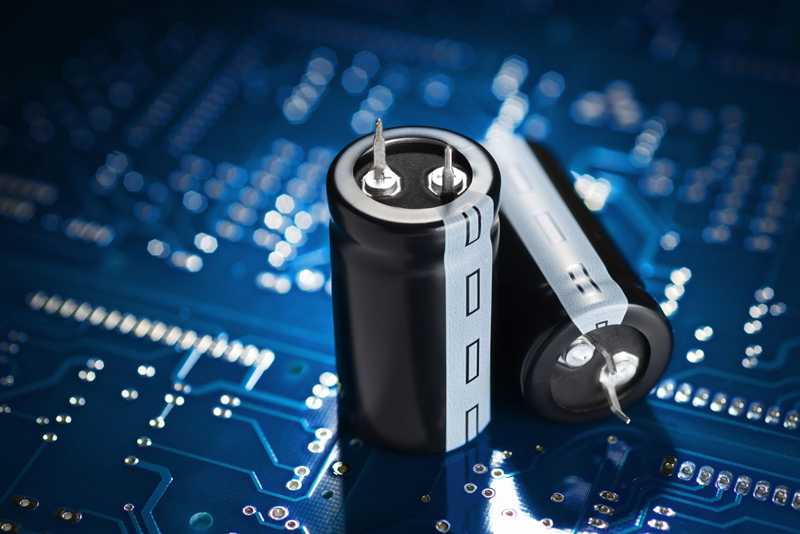
Capacitors are fundamental components found in nearly all electronic devices. Along with resistors and inductors, they are classified as "passive components"--the building blocks of electronic circuits. Unlike integrated circuits (ICs) and other active components that amplify signals or actively control current, capacitors function by storing and releasing electrical energy. While simple in concept, they are indispensable for ensuring the stable operation of complex active circuits.
Note: The three main passive components are often referred to as LCR (Inductor, Capacitor, and Resistor).
Basic Structure: Two Conductors and a Dielectric
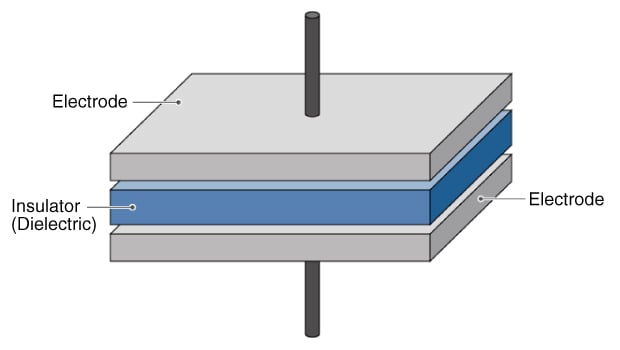
A capacitor typically consists of two conductive metal plates separated by an insulating material known as a "dielectric." Common dielectric materials include ceramics, plastic films, oxide films, and air.
When voltage is applied across the plates, current cannot flow through the dielectric. Instead, positive and negative charges accumulate on opposite plates, creating an electrostatic field. This mechanism allows the capacitor to store electrical energy. The amount of charge a capacitor can store (capacitance) and the frequencies it supports depend on the plate surface area, the distance between plates, and the properties of the dielectric material. Selecting the right capacitor is critical for meeting specific circuit requirements.
Key Functions of Capacitors in Electronic Circuits
Capacitors operate on two primary principles: storing electrical charge and blocking direct current (DC) while allowing alternating current (AC) to pass. Based on these properties, they play three critical roles in circuit design:
1) Energy Storage and Discharge
Due to their ability to store energy electrostatically, capacitors can function as temporary power sources. This feature is widely used in applications requiring sudden bursts of power, such as camera flashes. A capacitor accumulates charge over time and discharges it instantaneously to generate a high-intensity flash--a peak power output that the battery alone could not sustain.
2) Voltage Stabilization (Smoothing)
Capacitors are essential for maintaining stable voltage levels and reducing pulsation (ripple). In power supply circuits, rectified DC voltage often contains unstable AC components (ripples). By charging when the voltage rises and discharging when it drops, capacitors smooth out these fluctuations, ensuring a constant and stable DC output for sensitive electronic components.
3) Noise Filtering
Capacitors effectively remove unwanted noise from power lines and signal paths. Since high-frequency noise behaves like AC, it passes easily through a capacitor. By connecting a capacitor between a signal line and ground (bypass capacitor), high-frequency noise is shunted to the ground, allowing only the clean DC or low-frequency signal to pass through to the output circuit.
Types of Capacitors
- Aluminum Electrolytic Capacitors
- These capacitors use an oxide film formed on aluminum foil as a dielectric. They offer high capacitance and are cost-effective, making them a standard choice for power supply smoothing circuits. However, they generally have higher equivalent series resistance (ESR) and inferior frequency characteristics compared to other types.
- Tantalum Capacitors
- Using tantalum pentoxide as a dielectric, these capacitors provide high capacitance density in a compact package. They offer superior frequency characteristics and temperature stability compared to aluminum electrolytic capacitors, making them suitable for space-constrained applications requiring reliability.
- Electric Double-Layer Capacitors (Supercapacitors)
- Also known as supercapacitors, these devices offer capacitance values 1,000 to 10,000 times greater than standard electrolytic capacitors. They bridge the gap between capacitors and batteries, capable of millions of charge/discharge cycles without degradation. They are ideal for energy backup and energy harvesting applications.
- Ceramic Capacitors
- Ceramic capacitors are categorized by their dielectric constant (low vs. high dielectric types). They are characterized by their compact size, excellent heat resistance, and superior high-frequency performance. While they are the most widely used capacitor type, mechanical stress can cause cracking, so care is needed during board handling.
- Film Capacitors
- Using plastic films like polyester or polypropylene as the dielectric, these non-polarized capacitors offer high insulation resistance and low dielectric loss. They are highly reliable with excellent frequency and temperature characteristics, often used in audio circuits and high-voltage applications.
- Mica Capacitors
- Mica capacitors utilize natural mica as a dielectric. They are known for high precision, high stability, and high withstand voltage. While bulky and more expensive, they are ideal for high-frequency tuning circuits and precision instrumentation where stability is paramount.
For more details, please refer to: Types of Capacitors: A Basic Guide to Electronic Components
Related Technical Articles
Recommended products
Matsusada Precision's DC power supplies, high voltage power supplies, and X-ray inspection systems provide the best solutions for capacitor and electric component testing applications around the world.