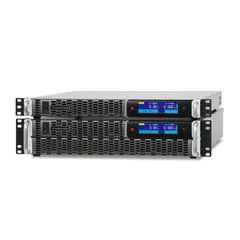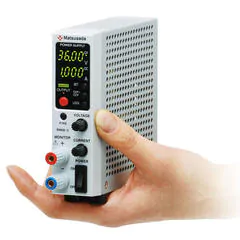

A power supply (or power supply unit) is an electrical device that supplies electric power to a load. While utility power is typically distributed as alternating current (AC), many electronic devices and industrial systems require stable direct current (DC) to operate. Devices that convert AC to DC are broadly classified as AC-DC converters or DC power supplies.
Other categories include DC-DC converters, which adjust DC voltage levels, and AC power sources, which convert voltage and frequency to simulate various grid conditions.
High-voltage (HV) power supplies are specialized units designed to output high voltage. When providing a DC output, they are referred to as high-voltage DC power supplies.
DC power supplies have positive (+) and negative (-) output terminals. A DC power supply can be used as a positive power supply by setting the negative pole to the ground potential, and as a negative power supply by setting the positive pole to the ground potential. It can also be used as a floating power supply, where neither terminal is referenced to ground, providing galvanic isolation for the output.
HV-DC power supplies are available in the positive (P) type, which can output only positive polarity; the negative (N) type, which can output only negative polarity; the reversible (R) type, which can switch polarity; and the PN type, which has output terminals for both positive and negative polarities.
Power supplies that can continuously alternate between positive and negative polarities include AC power sources, bipolar power supplies, bipolar amplifiers, and HV amplifiers. Programmable AC power sources provide a clean, stable output compared to standard utility grid power (mains power). They can also simulate global power grids by adjusting frequency and voltage, making them essential for export testing and compliance. It can also simulate regional AC power sources at different frequencies and voltages.
Bipolar power supplies and amplifiers are four-quadrant devices, meaning they can operate as both a source (supplying power) and a sink (absorbing power). Matsusada Precision distinguishes between bipolar power supplies, which feature built-in function generators for waveform creation, and bipolar amplifiers, which amplify external input signals. High-speed, high-voltage models within this category are referred to as HV amplifiers.
A power supply that functions as both a DC power supply (source) and a DC electronic load (sink), and can return the absorbed power to the AC power grid, is called a bidirectional or regenerative power supply. This capability is ideal for applications like battery cycle testers, which repeatedly charge and discharge batteries to evaluate their performance.
Other application-specific power supplies include those for electrostatic chucks used in semiconductor manufacturing equipment and piezoelectric drivers for piezoelectric devices.