
Carbon Film Resistors
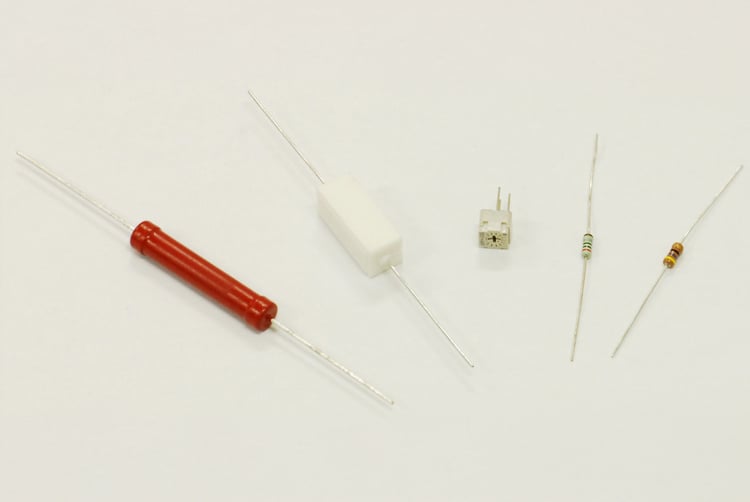
Carbon film resistors utilize a carbon-based film deposited on a ceramic carrier as the resistive element. While they are cost-effective and available in a wide range of resistance values, their temperature coefficient is generally higher than that of metal film types, making them less suitable for high-precision applications. Due to their balance of cost and performance, they are widely used in general-purpose circuits.
Solid Resistors (Composition Resistors)
Solid composition resistors consist of a mixture of carbon granules and a ceramic binder formed into a solid rod. These resistors are known for their high surge capability and robustness in harsh environments. While they offer excellent pulse resistance, their precision and temperature stability are generally lower compared to film-type resistors. They remain a niche choice for specific applications requiring high durability.
Metal Film Resistors
Metal film resistors feature a thin metal layer deposited on a ceramic substrate. They provide excellent precision (typically ±1% or better), low noise, and stable temperature coefficients. While generally more expensive than carbon film types, they are the standard choice for precision analog circuits and applications requiring high reliability.
Metal Oxide Film Resistors
Metal oxide film resistors use a resistive element formed from metal oxides formed at high temperatures. They are robust and cost-effective for medium-power applications (typically several watts). While their temperature stability is generally lower than that of metal film resistors, they offer excellent reliability at higher operating temperatures.
Wire-Wound and Cement Resistors
Wire-wound resistors are constructed by winding a metal resistance wire around a ceramic core. Due to their coil-like structure, they exhibit inductance, which may affect performance in high-frequency circuits. Cement resistors are a variation housed in a ceramic case filled with heat-conductive cement, offering excellent heat dissipation and durability for high-power applications.
Resistor Networks
A resistor network is a composite component that integrates several resistors into a single package. The advantages include a reduced component count, simplified assembly, and the ability to achieve high-density mounting on printed circuit boards.
Semi-Fixed Resistors (Trimmers)
A semi-fixed resistor, or trimmer, is a type of variable resistor intended for adjustment during manufacturing or circuit calibration. It can be set to a specific resistance value by turning an adjustment screw.
Related Technical Articles
Recommended products
Matsusada Precision's DC power supplies and high-voltage power supplies offer ideal solutions for resistor characterization and circuit testing.