
Fundamentals of Radiation Measurement: A Comprehensive Guide to Survey Meters, Their Roles, Types, and Structures
1. What Is a Survey Meter?
A survey meter is a portable radiation measuring instrument used to "survey" (inspect and measure) radiation contamination on objects or radiation levels in a given area, as its name implies.
Survey meters are indispensable tools for ensuring worker safety and environmental protection in any environment where radiation is handled, including nuclear power plants, medical facilities, research laboratories, and industrial sites.
Unlike fixed monitoring systems such as stationary radiation monitors or monitoring posts, survey meters offer excellent mobility, allowing users to move freely while checking, in real time, where radiation is present and how intense it is.
2. Main Applications of Survey Meters
Survey meters are generally used for two primary purposes depending on the application.
-
Ambient Dose Rate Measurement
Measures the radiation dose rate in a given space (units: μSv/h, etc.).
Survey meters are widely used for periodic leakage radiation measurements and safety inspections around X-ray inspection systems and radiation-utilizing equipment. -
Surface Contamination Inspection
Checks whether radioactive materials are attached to the surfaces of clothing, equipment, or other objects.
Measurements are typically expressed in cpm (counts per minute) and may be converted into Bq/cm² when necessary.
3. Classification of Survey Meters by Detection Principle
Radiation exists in various forms, including alpha (α) rays, beta (β) rays, gamma (γ) rays, and neutron radiation. To accurately measure these different types of radiation, survey meters are equipped with different detectors optimized for specific applications.
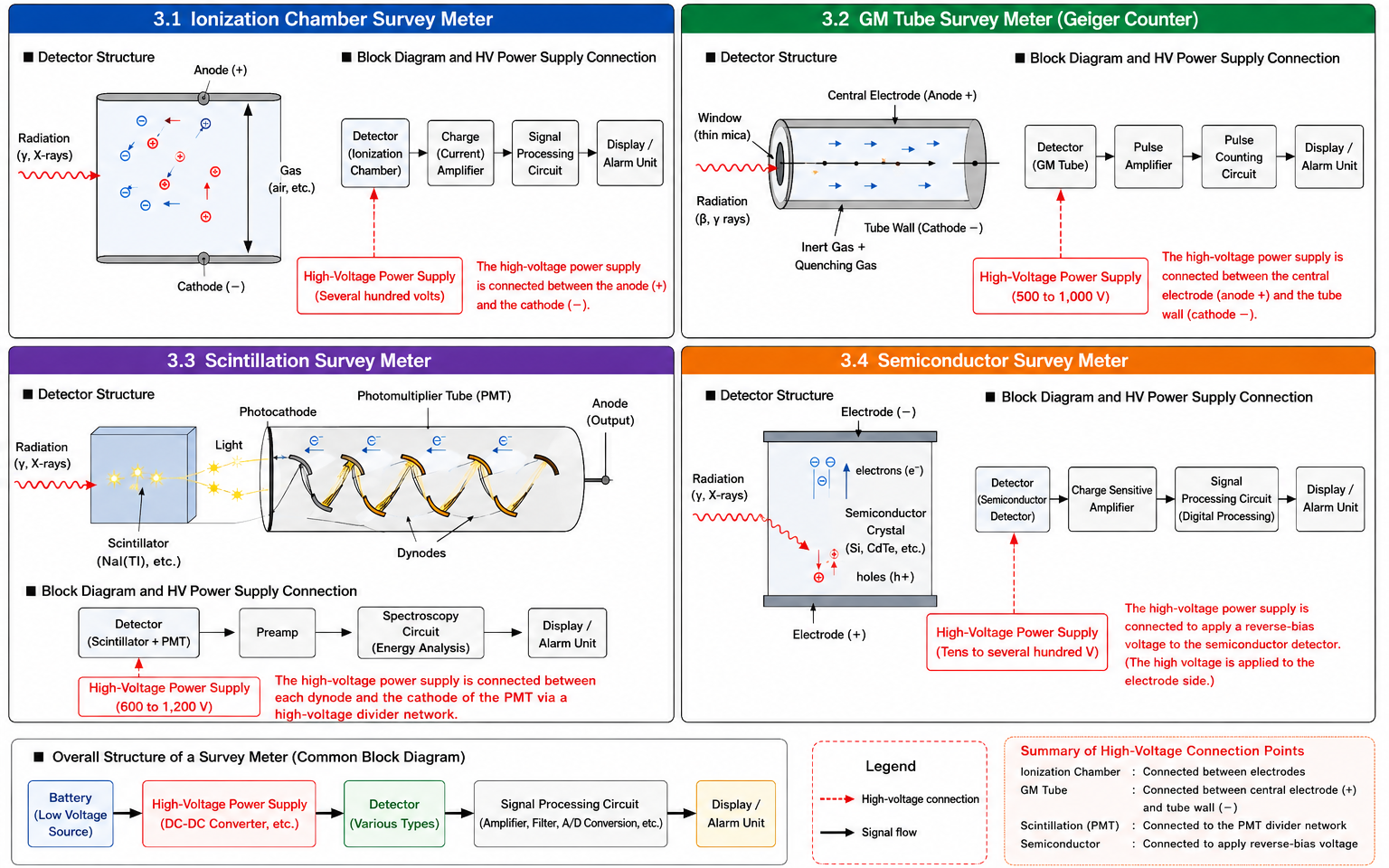
3.1 Ionization Chamber Survey Meters
This is one of the most fundamental and reliable radiation measurement methods.
-
Features
Because the response is relatively uniform over a wide radiation energy range (low energy dependence), ionization chamber survey meters are well suited for accurate dose measurements in sieverts (Sv).
-
Structure
The detector consists of a chamber filled with gas such as air, with an anode and cathode placed inside.
-
Operating Principle
When radiation passes through the chamber, gas molecules become ionized, producing electrons and positive ions. By applying a voltage across the electrodes, electrons move toward the anode and ions toward the cathode, generating a very small ionization current.
-
Role of the Power Supply
A constant voltage known as the saturation voltage is applied between the electrodes. Although the required voltage is typically several hundred volts, the measured current is extremely small (on the order of picoamperes), so leakage current and power-supply noise must be minimized as much as possible.
-
Main Applications
Leakage radiation measurements around X-ray systems and gamma-ray irradiation equipment.
3.2 GM Tube (Geiger-Müller) Survey Meters (Geiger Counters)
These highly sensitive instruments are well known for their characteristic clicking sound during radiation detection.
-
Features
GM survey meters respond sensitively even to small amounts of radiation. Because of their relatively rugged structure and ease of use, they are widely used for contamination inspections in the field.
However, they are not suitable for precise absolute dose measurements and are mainly used for presence detection and contamination monitoring. -
Structure
A thin central electrode (anode) is placed inside a tube filled with low-pressure inert gas and a small amount of quenching gas.
-
Operating Principle
When radiation enters the strong electric field inside the tube, a chain ionization reaction known as an electron avalanche occurs, producing a large pulse signal from a single radiation event.
-
Role of the Power Supply
A high voltage of approximately 500 V to 1,000 V is required to initiate the electron avalanche process.
After each discharge event, the tube voltage temporarily drops, so the power supply must provide both fast recovery response and stable operation that does not interfere with pulse counting. -
Main Applications
Detection of beta-ray surface contamination.
3.3 Scintillation Survey Meters
Scintillation survey meters offer extremely high sensitivity and are highly effective for detecting low levels of radiation.
-
Features
They provide excellent performance for ambient dose-rate measurement. By using crystals such as NaI(Tl), they can also measure radiation energy spectra and perform radionuclide analysis.
-
Structure
These detectors consist of a scintillator, which emits light when struck by radiation, and a photomultiplier tube (PMT), which amplifies the weak light signal into an electrical signal.
-
Operating Principle
Light generated in the scintillator strikes the photocathode of the PMT, causing electrons to be emitted. These electrons are then accelerated and multiplied through multiple dynode stages, ultimately producing a measurable current signal.
-
Role of the Power Supply
A high voltage of approximately 600 V to 1,200 V is required to operate the PMT.
One important characteristic is that the PMT gain is proportional to approximately the 6th to 10th power of the applied voltage. In other words, even a 1% fluctuation in supply voltage can result in nearly a 10% measurement error. Therefore, extremely high voltage stability is essential. - Main Applications Ambient dose-rate measurements in low-radiation environments and radionuclide analysis.
3.4 Semiconductor Survey Meters
Semiconductor-based survey meters have become increasingly popular in recent years due to advances in electronics and detector technology.
-
Features
These detectors can be made extremely compact and lightweight while allowing easy digital signal processing. They are also relatively resistant to mechanical shock and are widely used in personal dosimeters and pocket radiation meters.
-
Structure
Semiconductor detectors use materials such as silicon (Si) or cadmium telluride (CdTe).
-
Operating Principle
When radiation enters the semiconductor material, electron-hole pairs are generated. By applying an electric field, these charge carriers are collected as a measurable signal.
-
Role of the Power Supply
A reverse-bias voltage is applied to create a depletion layer, which serves as the sensitive detection region.
Although the required voltage is relatively low typically from several tens to several hundreds of volts the detector itself is highly sensitive, making a clean, low-ripple power supply essential. -
Main Applications
Personal dose management, compact dosimeters, and high-resolution radiation measurements.
It should be noted that survey meters are used to measure ambient radiation levels and contamination, whereas personal dosimeters are designed to record an individual's cumulative radiation exposure.
4. Internal Structure Supporting Survey Meters
Survey meters generally perform radiation measurement and display through the following three processes:
-
Detector Unit
Detects radiation and converts it into physical changes such as electrical charge or light.
-
Signal Processing Circuitry
Amplifies weak detector signals, removes noise, and converts the signals into digital data for calculation and display.
-
Display and Alarm Section
Displays measured values on an LCD screen and activates audible or visual alarms when preset thresholds are exceeded.
5. The Core Technology: High-Voltage Systems Supporting Radiation Detectors
The heart of a survey meter is the detector, which converts radiation into electrical signals. Stable high-voltage power supplies are essential for proper detector operation.
- Ionization chambers require voltage to collect ions.
- GM tubes require high electric fields to generate electron avalanches.
- Photomultiplier tubes require multi-stage electron multiplication.
These functions require high voltages ranging from several hundred volts to several kilovolts.
Particularly in scintillation detectors and high-resolution measurements, even slight voltage fluctuations or electrical noise can directly affect measurement accuracy and cause measurement errors.
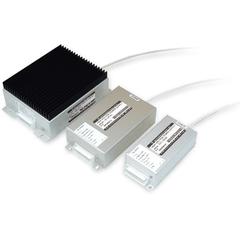
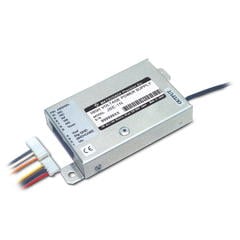
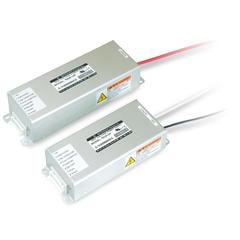
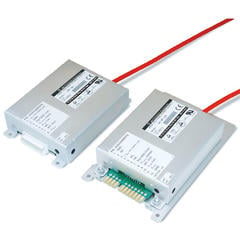
The reason portable survey meters can maintain stable measurement performance is the advanced high-voltage power technology that precisely converts the low voltage of internal batteries into highly stable high-voltage outputs.
6. Four Technical Requirements for High-Voltage Power Supplies in Survey Meters
Survey meters must achieve both measurement accuracy and portability. To support these requirements, the high-voltage power supply must satisfy several critical characteristics.
① Ultra-Low Ripple and High Stability
Radiation detection signals are extremely weak. If ripple voltage is present in the power supply output, it can mix into the signal as electrical noise and cause measurement errors.
In high-resolution energy analysis applications, voltage stability at the ppm to 0.01% level may be required.
② Excellent Temperature Characteristics
Survey meters are used in harsh environments ranging from outdoor winter conditions to high-temperature industrial facilities.
If the power supply voltage changes with ambient temperature, measurement results may vary depending on the environment. Therefore, excellent temperature coefficients and stable operation across a wide temperature range are essential.
③ Compact Size, Lightweight Design, and Low Power Consumption
Most survey meters are battery-powered handheld instruments.
The internal high-voltage power module must combine high-density packaging technology with high conversion efficiency to maximize battery life while fitting within limited internal space.
④ Fast Response and Protection Circuits
When approaching strong radiation sources, detectors may experience sudden load changes.
The power supply must respond quickly enough to maintain stable voltage under these conditions. In addition, sophisticated protection circuits are required to protect sensitive detectors from overvoltage and short-circuit conditions.
7. Practical System Configuration and Circuit Design Considerations
Inside a survey meter, high voltage is generated from a low-voltage battery source and supplied to the detector.
-
High-Voltage Step-Up Circuit Selection
High-voltage DC-DC converters are commonly used. Depending on the application, flyback converters, Cockcroft-Walton (CW) circuits, and resonant topologies may be employed.
-
Insulation Technology
Because high voltage must be handled within a compact enclosure, insulation design is critically important.
PCB pattern layout and potting (resin encapsulation) techniques help prevent leakage caused by moisture or dust while ensuring long-term reliability.
8. Conclusion: Power Supply Selection Determines System Reliability
The performance of a survey meter depends not only on the detector itself, but also on the quality of the high-voltage power supply driving it.
-
Improved Accuracy:
Better signal-to-noise ratio through low-ripple, highly stable power supplies.
-
Enhanced Reliability:
Stable output even under harsh environmental conditions.
-
Added Value:
Improved mobility through compact, energy-efficient design.
In measurement equipment development, the power supply is not merely a component it is the foundation of the entire system.
Selecting the optimal high-voltage power supply for the application is one of the keys to realizing next-generation high-performance survey meters.
Choosing the appropriate detection method for each application is essential when using survey meters. Understanding the characteristics of ionization chambers, GM tubes, scintillation detectors, and semiconductor detectors enables proper radiation management in the field.
Behind the measurement accuracy of these instruments lies advanced power-supply technology that brings radiation detectors to life.
- Related words:
-
- Radiation Detection
- Ionization Chamber
- Geiger counter
- Radiation monitor
- Radiation Leakage Dose
- X-ray leakage measurement
- Photomultiplier tube
- High-voltage power supply
- High-voltage DC-DC converter
- Scintillation detector
- Detector