
A Microchannel Plate (MCP) is a specialized component designed to amplify weak electron signals. It serves as a key element in two-dimensional detectors used to sense ions, photons, charged particles, and high-energy radiation such as X-rays and gamma rays. These detectors are essential for applications requiring high sensitivity and fast response times.
Structure and Operating Principle
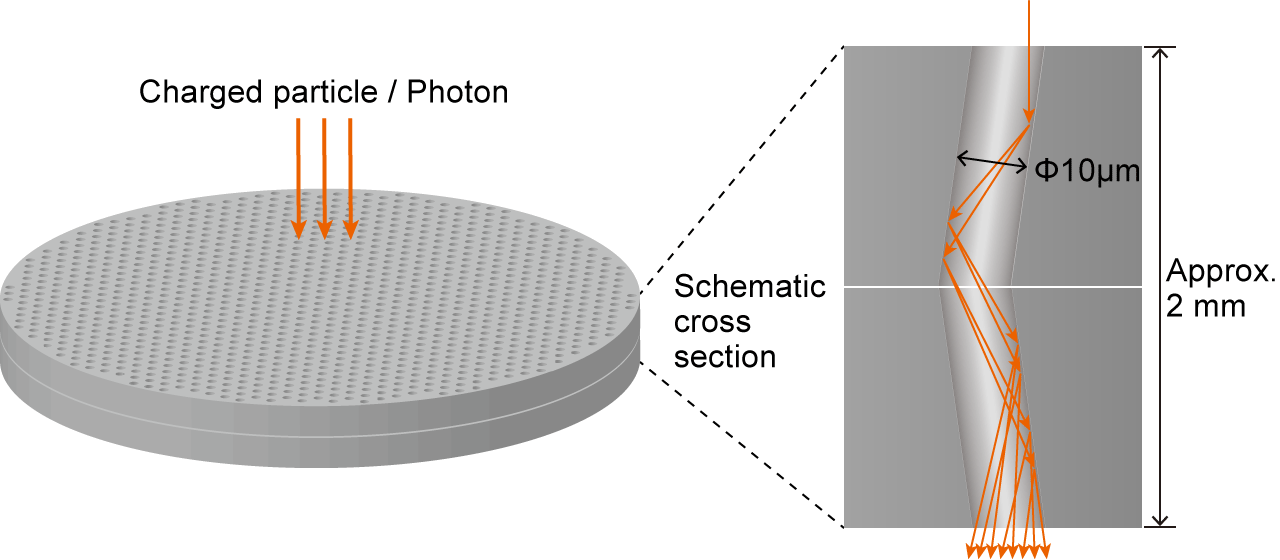
An MCP consists of a thin plate (typically about 2 mm thick) made from highly resistive semiconductive glass. The plate contains a dense array of microscopic channels (microchannels) functioning as independent electron multipliers. These channels typically have a diameter of 10 μm and a pitch (center-to-center spacing) of approximately 15 μm.
The channels are tilted at a small bias angle relative to the plate's surface. This geometry is crucial for preventing ion feedback and ensuring stable signal amplification. During operation, a DC high voltage--ranging from several hundred volts to a few kilovolts--is applied across the plate.
Signal Amplification
When a charged particle or photon strikes the input surface, it triggers the release of primary electrons. The electric field accelerates these electrons into the microchannels. As they strike the inner walls, secondary electrons are emitted, creating a cascading "electron avalanche." While a single MCP provides significant gain, stacking plates (such as Chevron or Z-stack configurations) allows for signal amplification factors of 10^4 to 10^7 or higher. The resulting electron cloud is then captured by an anode or converted into light by a phosphor screen at the output.
Common Applications
Microchannel plates are widely used in scientific and industrial instruments, including:
- Mass Spectrometry (TOF-MS, SIMS)
- Scanning Electron Microscopes (SEM)
- X-ray and UV Imaging
- Night Vision Devices (Image Intensifiers)
- High-energy Physics Experiments
- Related Terms:
-
- MCP
- Microchannel Plate
- Charged particle
- Ion
- Vacuum ultraviolet light
- X-ray
- Gamma-ray
- Night vision
- SIMS
- SEM
Recommended products
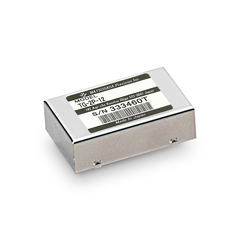
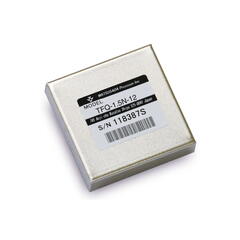
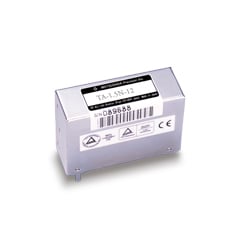
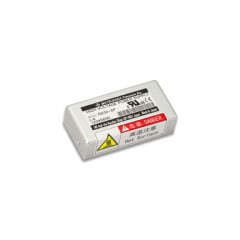
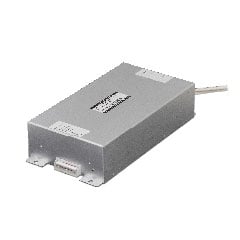
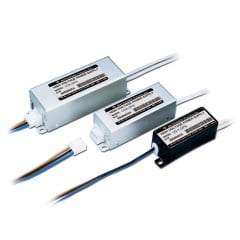
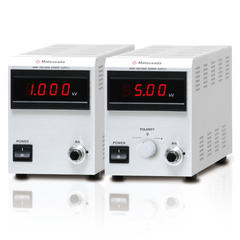
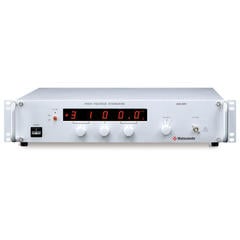
High-Voltage Power Supplies for MCP Applications
To achieve optimal gain and prevent signal degradation, MCP detectors require high-voltage power supplies with exceptional stability and low ripple noise. Matsusada Precision offers a wide range of compact, high-reliability high-voltage power supplies optimized for biasing MCPs and photomultiplier tubes (PMTs).