
What Is an Ion Beam?
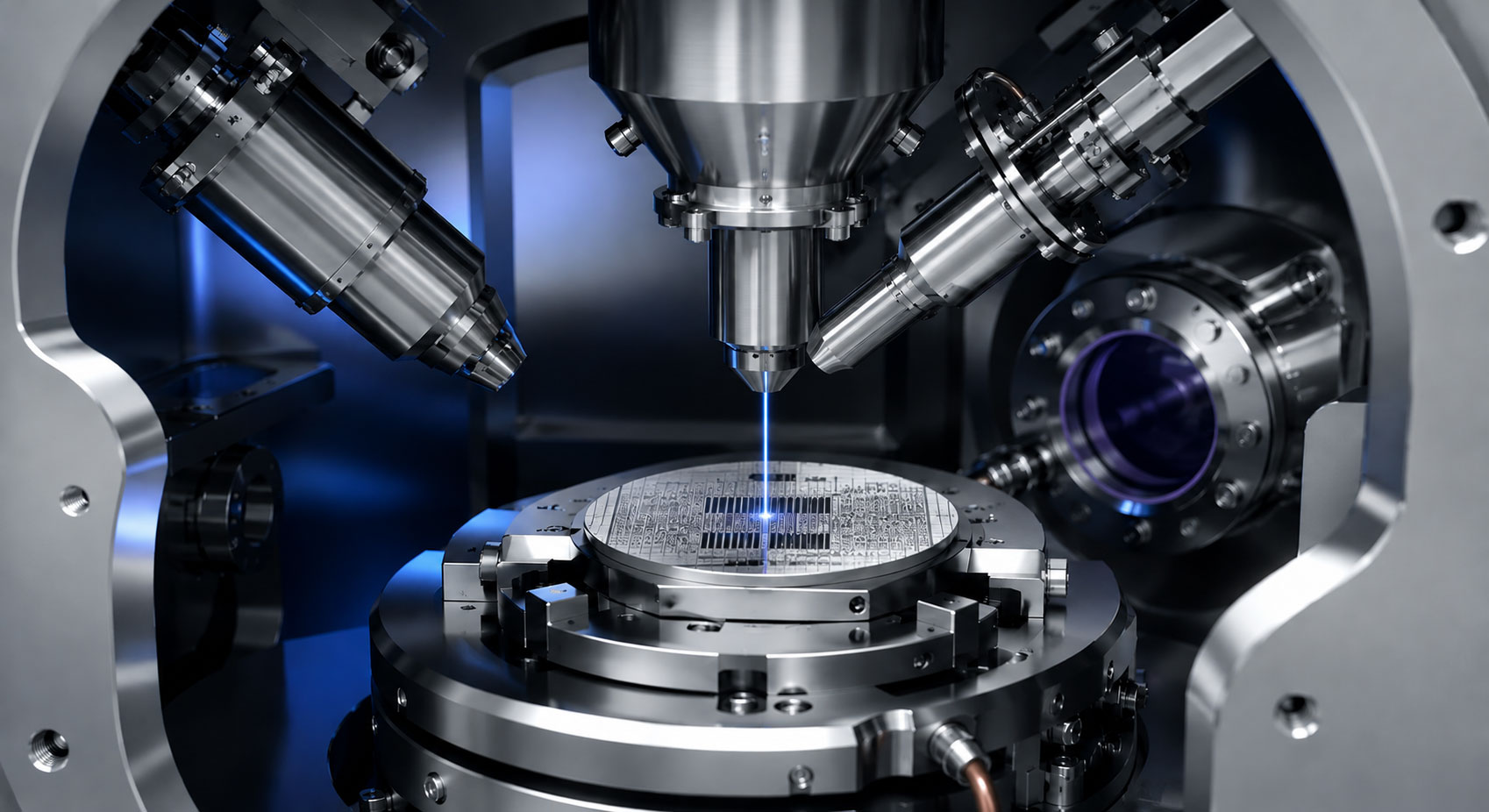
An ion beam is a technology that accelerates ions--atoms or molecules carrying an electrical charge-and directs them onto a material in a fine, focused beam.
While an electron beam utilizes only electrons, an ion beam employs larger, heavier particles with either a positive or negative charge. Their greater mass enables ion beams to implant specific elements into materials and modify or remove surface atoms with high precision.
From nanometer-scale precision processing to elemental analysis within materials, ion beams have become indispensable tools in advanced semiconductor manufacturing, materials research, and surface engineering applications.
Principles of Ion Beams
The generation and control of an ion beam generally involve the following four steps:
-
Plasma Generation (Ionization)
Energy is applied to a source gas or vapor to induce the emission or attachment of electrons, thereby generating ions. In most cases, a plasma state is formed within the ion source.
-
Extraction
An electric field is applied to the ions generated within the ion source, extracting them and forming a directed ion beam.
-
Acceleration
A high voltage is applied to the extracted ions, accelerating them to the desired energy level. Beam energy is a critical parameter that determines implantation depth, processing characteristics, and analytical performance.
-
Transport and Control
Electromagnets and electrostatic lenses are used to transport and control the beam. These systems perform beam deflection, focusing, and mass separation, enabling highly precise delivery of ions to the target.
Applications of Ion Beams
Thanks to their precise energy control and high processing accuracy, ion beams are utilized across a wide range of industrial and scientific fields.
-
Ion Implantation (Semiconductor Manufacturing)
Dopant ions are implanted into semiconductor materials such as silicon wafers to tailor their electrical properties by forming n-type and p-type regions. Ion implantation is a fundamental process in modern semiconductor device fabrication.
-
Surface Modification and Thin-Film Deposition
By bombarding material surfaces with ions, various surface properties can be enhanced, including hardness, wear resistance, and adhesion. Ion beams are also widely used in thin-film processes such as Ion Beam Assisted Deposition (IBAD) and ion beam sputtering.
-
Elemental Analysis (e.g., PIXE)
In Particle-Induced X-ray Emission (PIXE), a sample is irradiated with an ion beam, and the resulting characteristic X-rays are measured. This technique enables highly accurate, non-destructive analysis of trace elements at ppm-level concentrations.
Power Supplies Required for Ion Beam Systems
An ion beam system consists of multiple power supply subsystems, including high-voltage, high-current, and RF power supplies. Because power supply performance directly affects beam quality and process precision, high stability and reliability are essential.
1. High-Voltage Power Supplies (Extraction and Acceleration)
- Role
-
Extract ions from the plasma and accelerate them to the required energy level.
- Typical Specifications
-
- A few kV to several tens of kV (extraction electrodes)
- Tens of kV to hundreds of kV (ion implanters)
- Several MV or higher (large-scale particle accelerators)
- Key Considerations
-
Beam energy is determined by the applied voltage. Voltage ripple and long-term drift directly affect implantation depth, beam energy stability, and analytical accuracy. Therefore, extremely high voltage stability and low-noise performance are required.
2. High-Stability Current Power Supplies (Electromagnet Driving)
- Role
-
Drive analyzer magnets for mass separation, bending magnets for beam steering, and electromagnetic lenses for beam focusing.
- Typical Specifications
-
- A few amperes to several hundred amperes
- Key Considerations
-
Magnetic field fluctuations can cause beam trajectory deviations and changes in beam diameter. To ensure analytical accuracy and implantation uniformity, ultra-low ripple and highly stable current regulation are essential.
3. RF Power Supplies (Ion Sources)
- Role
Generate high-density plasma within the ion source.
- Key Considerations
-
RF and microwave power supplies are commonly used in Inductively Coupled Plasma (ICP) and Electron Cyclotron Resonance (ECR) ion sources. The stability of plasma density directly affects beam current stability and overall process consistency.
4. High-Precision Low-Voltage Power Supplies (Lens and Deflection Control)
- Role
-
Drive electrostatic lenses and deflection electrodes to control beam focusing and scanning.
- Key Considerations
-
High-resolution processing and precise beam positioning require exceptionally accurate voltage control with minimal fluctuation and noise.
Summary: A Power Supply Manufacturer's Perspective
Ion beam systems represent some of the most demanding applications in power supply technology, requiring high voltage, high current, and exceptional stability.
Even minor fluctuations in voltage or current can appear as variations in beam energy or beam trajectory, directly affecting semiconductor device yields, process repeatability, and analytical accuracy. Furthermore, high-voltage systems operating from tens to hundreds of kilovolts require robust insulation design, high reliability, and effective arc protection capabilities.
Leveraging our expertise in high-performance, compact, and low-noise high-voltage power supply technologies, we provide optimized power solutions tailored to the demanding requirements of ion beam applications.
- Related Terms:
-
- Ion beam
- Ion gun
- High-voltage power supply
- FIB
- Electron microscope
- Accelerating voltage
- Ion implantation
- SEM (scanning electron microscope)