
In electronics, bias refers to a fixed DC voltage or current applied to an active device--such as a transistor, sensor, or vacuum tube--to establish its proper operating point. A stable and precise bias voltage is critical for ensuring accurate signal processing and device performance.
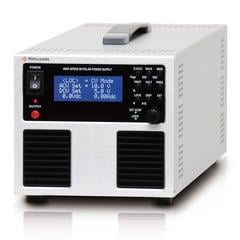
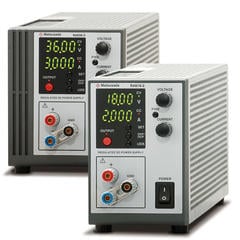
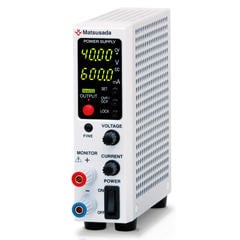
Matsusada Precision offers a wide range of power supplies designed for biasing applications. Our bipolar power supplies and high-voltage amplifiers allow users to apply precise DC offsets to output voltages, making them ideal for characterizing devices under test.
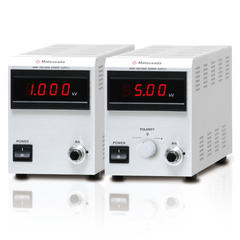
For high-sensitivity measurement applications, our compact high-voltage power supplies are widely used to bias detectors, including Photomultiplier Tubes (PMTs), Microchannel Plates (MCPs), and photodiodes. These power supplies provide the low ripple and high stability required to minimize noise in detection systems./p>
Forward and Reverse Bias
Understanding bias direction is fundamental when working with diodes and semiconductors:
- Forward Bias: A positive voltage is applied to the P-type material (anode) and a negative voltage to the N-type material (cathode). This configuration allows current to flow easily. Light-emitting diodes (LEDs) operate under forward bias to emit light.
- Reverse Bias: A negative voltage is applied to the anode and a positive voltage to the cathode. This prevents current flow in standard diodes but is essential for photodiodes. Under reverse bias, photodiodes generate a current proportional to light intensity, enabling precise light detection.
- Related Terms:
-
- DC Bias
- Grid Bias
- Forward Biasing
- Reverse Biasing
- Pulse Bias
- Bias Power Supply