
Microwaves are a type of radio wave. While multiple definitions exist, the term primarily refers to electromagnetic waves with a frequency range of approximately 300 MHz to 300 GHz.
Microwaves are used in a wide variety of applications. The most common everyday examples include satellite communications, such as TV broadcasting, and microwave ovens.
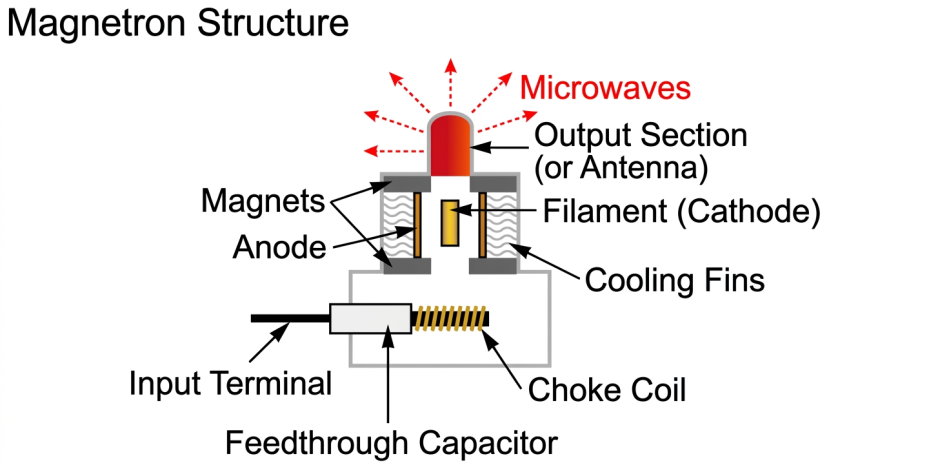
To generate microwaves, vacuum tubes like magnetrons and klystrons are often utilized. In a magnetron, electrons emitted from a central cathode are accelerated by an electric field. These electrons are then forced into a circular motion by a magnetic field, inducing high-frequency oscillations in the resonant cavities of the anode block. The generated microwave energy is then extracted through an antenna or waveguide.
Unlike magnetrons, klystrons amplify microwaves by modulating and bunching an electron beam as it passes through resonant cavities. They are widely used in radar systems, satellite communications, particle accelerators, and scientific research requiring high output power and frequency stability.
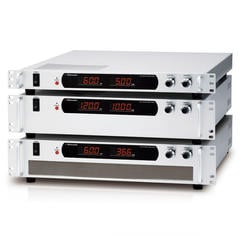
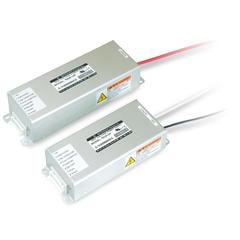
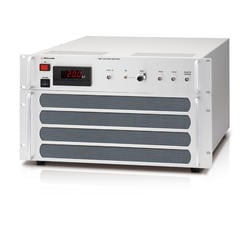
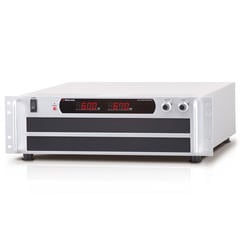
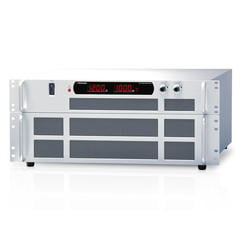
High-voltage power supplies are essential for emitting, accelerating, and controlling electron beams in vacuum tubes such as magnetrons and klystrons. As a long-established manufacturer of high-voltage power supplies, Matsusada Precision offers one of the industry's most comprehensive lineups--ranging from rack-mount and benchtop models to embedded modules. From our diverse product portfolio, we can help you select the most suitable high-voltage power supply for your application.
- Related Terms:
-
- Magnetron
- Klystron
- Microwave
- Electromagnetic wave
- High frequency (RF)
- Waveguide
- RF Power
- Resonant Cavity
- Vacuum tube
Recommended products
Matsusada Precision offers a comprehensive selection of high-voltage power supplies. We take pride in our industry-leading lineup, which spans from rack-mount systems, benchtop power supplies, and embedded high-voltage modules.