
What is Glow Discharge?
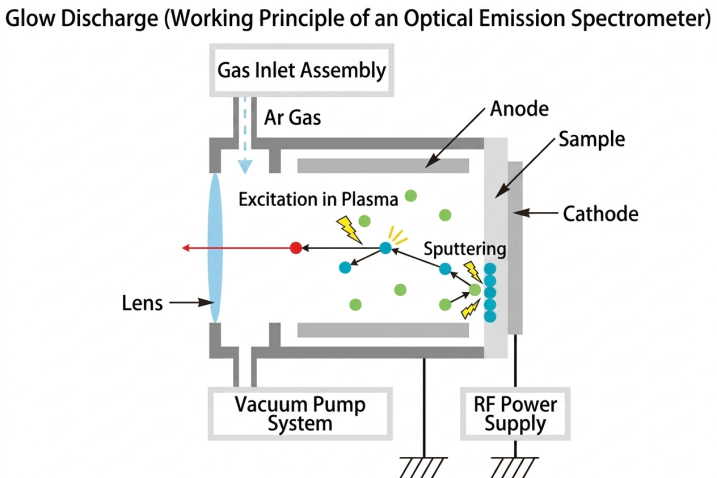
Glow discharge is a phenomenon where a continuous electrical discharge occurs within a low-pressure gas. When a voltage is applied between two electrodes inside a discharge vessel kept at low pressure, the charged particles between the electrodes accelerate. Positive ions collide with the negative electrode (cathode), triggering secondary electron emission. These emitted electrons then ionize and excite the gas molecules gas molecules in the discharge vessel, generating a self-sustaining plasma that allows a continuous electric current to flow.
During this process, light is emitted as the excited gas molecules return to a lower energy state. The color of this light varies depending on the type of gas used. Note that if the current flowing between the electrodes increases beyond a certain threshold, the discharge will transition into an arc discharge, ending the stable glow discharge state.
Applications of Glow Discharge
By utilizing the characteristic glow generated by continuous gas excitation, glow discharge is also widely used in sputtering systems, plasma cleaning equipment, optical emission spectrometers, glow discharge mass spectrometers (GD-MS), and plasma surface treatment systems. Compared to incandescent bulbs, these applications feature lower power consumption and a longer lifespan.
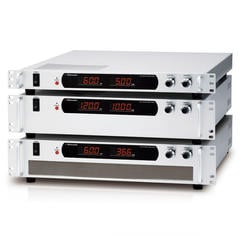
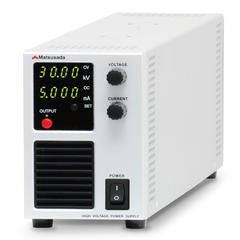
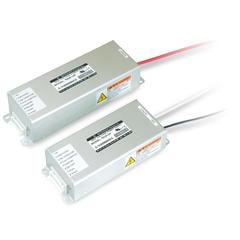
Because initiating and maintaining a stable glow discharge requires precise high-voltage application between the electrodes, a highly stable power supply is essential. Matsusada Precision offers a comprehensive lineup of power supply equipment, including the advanced high-voltage power supplies required for precise glow discharge generation.
- Related Terms:
-
- Glow Discharge Spectroscopy (GDS)
- Glow Discharge Mass Spectrometry (GD-MS)
- Optical Emission Spectroscopy (OES)
- Plasma
- Sputtering
- Plasma Cleaning
- Fluorescent Lamp
- Xenon Flash Lamp
- Neon Lamp
- Arc Discharge