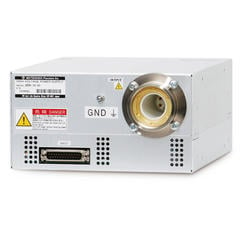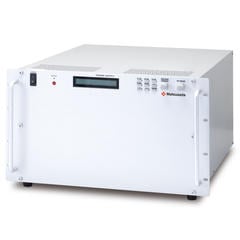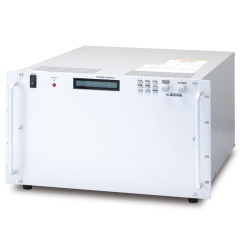

A floating power supply features an output that is electrically isolated from both the input and the chassis ground. Unlike standard DC power supplies, where one output terminal is typically connected to earth ground, a floating power supply allows its entire output to be referenced to an external voltage potential. This capability is achieved through a design that ensures high dielectric strength (high isolation) between the input and output circuits.
Common applications include biasing microchannel plates (MCPs) in mass spectrometry, driving filaments in anode-grounded X-ray tubes, and powering filaments, grids, and electrostatic lenses in scanning electron microscopes (SEM) and transmission electron microscopes (TEM). They are also essential for controlling suppressor and extractor electrodes in focused ion beam (FIB) systems.
When selecting a floating power supply, it is crucial to ensure that the isolation voltage (dielectric strength) exceeds the external floating potential. The unit must also meet the specific voltage and current requirements of the load.

In this diagram, both the filament heating power supply and the Wehnelt bias power supply are floating power supplies, referenced to the high-voltage potential of the electron gun.
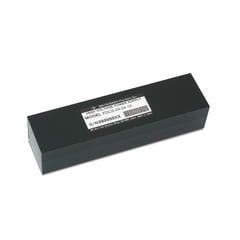
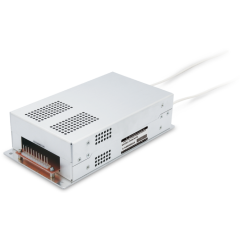
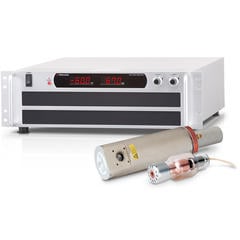
Matsusada Precision offers a comprehensive lineup of floating power supplies. The FDCS, MDC, and FDC series are high-isolation DC-DC converters designed to operate at high potentials. For integrated system requirements, we provide the XPg series for X-ray tubes, the SEM series for electron microscopes, and the HEB and HIB series for beam applications, all of which feature built-in floating power stages.