
Electrohydrodynamics (EHD) is the study of the dynamics of electrically charged fluids. It utilizes the interaction between electric fields and fluids (gases and liquids) for precise transport and control. A key advantage of EHD systems is the absence of mechanical moving parts, enabling silent operation, compact design, and maintenance-free performance.
A high-voltage power supply is the core component that drives EHD phenomena. The performance and reliability of EHD-based equipment depend critically on the precision, stability, and responsiveness of the applied voltage.
This article explains the basic principles of EHD, its fields of application, and the high-voltage power supply requirements for each application.
Basic Principles of EHD
EHD phenomena generate fluid flow by directly imparting momentum to the fluid using electrical forces. It uses electrical forces (such as Coulomb force and dielectrophoretic force) exerted by an electric field on charged particles (ions) or dielectric particles within the fluid. This phenomenon is described by coupling Maxwell's equations from electromagnetism with the Navier-Stokes equations from fluid dynamics.
The EHD body force density, fe, which drives the fluid motion, is described by the following equation. The first term represents the Coulomb force, which acts on free charges. The second and third terms are forces arising from dielectric polarization: the dielectrophoretic force and the electrostrictive force, respectively.
Some of the most representative phenomena utilized in EHD include ionic wind, dielectrophoresis, and electro-osmotic flow.
Key EHD Phenomena and Required High-Voltage Power Supplies
Ionic Wind (Corona Wind)
Ionic wind, also known as corona wind, is generated by applying a high DC voltage between a sharp, needle-like electrode and a counter electrode. This configuration creates a corona discharge. This produces and accelerates ions, which then generate an airflow through collisions with surrounding neutral gas molecules.
- Application Fields
- Electronic equipment cooling, air purification, static elimination (ionizers).
- Required Power Supply Characteristics
- Voltage/Polarity: A stable DC high voltage from several kV to tens of kV. Both positive and negative polarity outputs may be required.
- Stability/Ripple: To maintain a stable discharge, a low-ripple, high-stability output is essential. Voltage fluctuations can lead to uneven ion generation and, consequently, unstable airflow velocity.
- Controllability: To precisely control the airflow speed, a high-precision output voltage control function via external analog signals or digital communication is required.
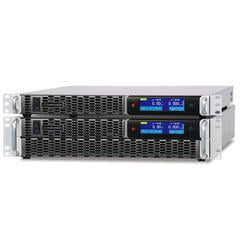
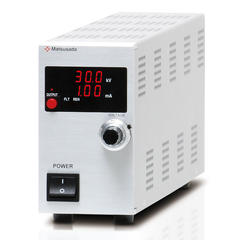
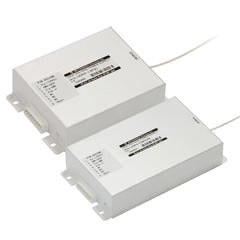
Matsusada Precision's Solutions: For basic research, the high-stability, low-ripple digital high-voltage DC power supply HARS series is ideal. For product integration, compact and high-efficiency high-voltage power supply modules are most suitable.
Dielectrophoresis (DEP)
Dielectrophoresis (DEP) is a phenomenon in which a force is exerted on a dielectric particle when it is subjected to a non-uniform electric field. This force, which arises from polarization, can be used to manipulate and move particles. It is particularly used for the separation and manipulation of microparticles (such as cells, bacteria, and nanoparticles) in liquids.
- Application Fields
- Cell separation, water quality inspection, drug delivery.
- Required Power Supply Characteristics
- Output Type: High-frequency AC voltage is necessary to efficiently generate a non-uniform electric field.
- Frequency/Waveform: Variable frequency capability (kHz to MHz range) is essential, as the optimal frequency depends on the complex permittivity of the target particles. Support for various waveforms, such as sine and square waves, is also recommended.
- Fast Response: For dynamic particle manipulation, high-speed high-voltage amplifiers capable of rapid signal modulation are effective.
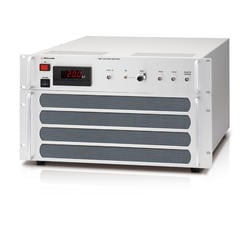
Matsusada Precision's Solutions: High-voltage amplifiers/fast high-voltage power supplies, which can freely output high-speed, high-voltage waveforms, strongly support dynamic EHD control experiments like dielectrophoresis.
Electro-osmotic Flow (EOF)
This phenomenon drives the bulk fluid by applying an electric field along a microchannel to the electric double layer formed at the interface between the microchannel's inner wall and the liquid.
- Application Fields
- MEMS, Lab-on-a-Chip, DNA sequencers, micro-volume liquid pumps.
- Required Power Supply Characteristics
- Voltage/Current: While requirements typically range from tens of volts to several kilovolts, precise voltage control is critical for flow stability.
- Noise Characteristics: In microfluidic applications, output ripple directly disrupts flow. Ultra-low ripple and low-noise performance are mandatory.
- Polarity Switching: A power supply with high-speed polarity switching is often required to enable instantaneous reversal of the flow direction.
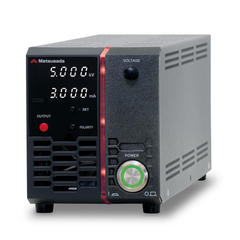
Matsusada Precision's Solutions: For precise benchtop experiments, the HJPSS series, which achieves ultra-low ripple, is optimal. It is also possible to provide these performance features in a compact module for OEM integration.
Soft Robotics and Haptics (HCI)
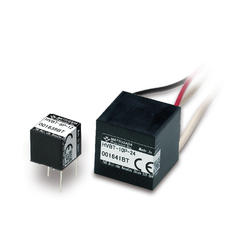
With no moving parts and silent operation, EHD pumps are ideal for soft actuators and wearable devices. Integrating our ultra-compact high-voltage power supplies (e.g., HVBT series) enables "untethered" (battery-powered and portable) systems, which were previously difficult to achieve. This technology is increasingly used in the field of Human-Computer Interaction (HCI), including artificial muscles, haptic feedback gloves, and microfluidic devices.
Key Points for Selecting a Power Supply for EHD Applications
To succeed in research and product development applying EHD technology, it is necessary to select a high-voltage power supply from a comprehensive perspective based on the following points.
| Selection Criteria | Description |
|---|---|
| Output Voltage/Current | Does it sufficiently meet the voltage and current range required by the application? |
| Polarity | Is a positive, negative, or bipolar output required? |
| Stability/Ripple | This is the most critical item directly affecting the stability and reproducibility of the phenomenon. The required specifications must be clarified. |
| Response Speed | If dynamic control or fast ON/OFF is needed, a high-speed response power supply such as a high-voltage amplifier is essential. |
| Controllability/Interface | Does it support external control (analog, digital communication, etc.) from a PC or PLC? |
| Size/Shape | Is it for product integration (OEM) or benchtop use in a laboratory? |
| Safety/Reliability | Since it handles high voltage, output protection functions, compliance with safety standards, and reliability for long-term continuous operation are important. |
Featured Case Study: Wireless Hydraulic Prototyping
Our HVBT Series ultra-compact high-voltage power supply was featured in the research paper "HydroMod: Constructive Modules for Prototyping Hydraulic Physical Interfaces" presented at CHI '22.
- Challenge: Traditional EHD systems required bulky, tethered power supplies, limiting mobility.
- Solution: By integrating the HVBT-10P-5, researchers developed palm-sized, wireless hydraulic modules.
- Result: Enabled the rapid prototyping of untethered soft robotic interfaces and wearable haptic devices.
Source: HydroMod (ACM CHI 2022) - Shibaura Institute of Technology, The University of Tokyo, et al.
Conclusion
EElectrohydrodynamics (EHD) is expanding into diverse industrial and medical fields. To unlock the full potential of EHD technology, selecting the right high-voltage power supply is paramount.
Matsusada Precision offers a comprehensive lineup of high-voltage solutions, from benchtop units for basic research to compact modules for OEM integration. Our extensive experience in high-voltage engineering ensures we can meet the demanding requirements of EHD applications.
For assistance with power supply selection or custom configurations, please contact us.
Our high-voltage power supplies and high-voltage amplifiers are used in research on electrohydrodynamic.
- HydroMod : Constructive Modules for Prototyping Hydraulic Physical Interfaces
- Our product:High Voltage Power Supplies (URT-10P-5 (Japanese model: HVBT-10P-5), EQ-30P1 (Japanese model: HJPQ-30P1))
- LayerPump: Design and Fabrication of Functional 3D Objects with Built-in Electrohydrodynamics Pumps based on Layered Plates
- Our product:High Voltage Amplifiers (URT-10), Benchtop High Voltage Power Supplies (EQ-30P1)
- Industrial applicability of grain drying technology based on electrohydrodynamic phenomena in developing countries
- Our product:High Voltage Amplifiers (AMP-10B10)
- High-density, high-frequency and large-scale electrohydrodynamic drop-on-demand jetting via a protruding polymer-based printhead design
- Our product:High Voltage Amplifiers (AMP-10B10)
- Silicone-based highly stretchable multifunctional fiber pumps
- Our product:High Voltage Amplifiers (HOPP-10P(A))
- Related Terms:
-
- Electrohydrodynamics (EHD)
- Maxwell's equations
- Navier-Stokes equations
- Ionic Wind, Dielectrophoresis (DEP)
- Electro-osmotic Flow (EOF)
- Artificial Muscle (HASEL Actuator)