
What is Cosmic Ray Irradiation?
Cosmic ray irradiation refers to testing that artificially generates high-energy particles using particle accelerators or similar equipment to irradiate materials and electronic devices, to simulate radiation environments associated with cosmic rays.
Cosmic rays primarily consist of high-energy protons and atomic nuclei traveling through outer space. When they interact with Earth's atmosphere, they generate secondary particles, such as neutrons and muons. These particles can interact with electronic devices and materials, affecting their performance and reliability.
In cosmic ray irradiation testing, accelerators generate proton beams, heavy ions, and neutron beams to recreate actual space or high-radiation environments within a short timeframe. This allows for the efficient evaluation of the radiation hardness of electronic equipment and the radiation resistance of materials.
Principle of Cosmic Ray Irradiation
Artificial cosmic ray irradiation is carried out through the following primary processes:
-
Particle Generation and Acceleration
Particles such as electrons, protons, and heavy ions are generated and then accelerated to near the speed of light using radiofrequency (RF) power within an accelerator. The energy level of the particles is precisely controlled according to specific testing conditions.
-
Beam Control
The accelerated particles are transported in the form of a "beam." The beam trajectory is controlled using dipole magnets, while quadrupole magnets are used to focus and shape the beam for precise irradiation of the target.
-
Target Irradiation
The controlled high-energy particles irradiate evaluation targets such as semiconductor devices, electronic components, and advanced materials, allowing for the measurement of their impact. Analyzing changes in electrical characteristics and structural alterations induced by the irradiation enables the evaluation of radiation hardness and reliability.
Applications of Cosmic Ray Irradiation
Cosmic ray irradiation is utilized across a wide range of fields, from aerospace development to advanced materials research.
-
Radiation Hardness Evaluation of Semiconductor Devices (SEE Testing)
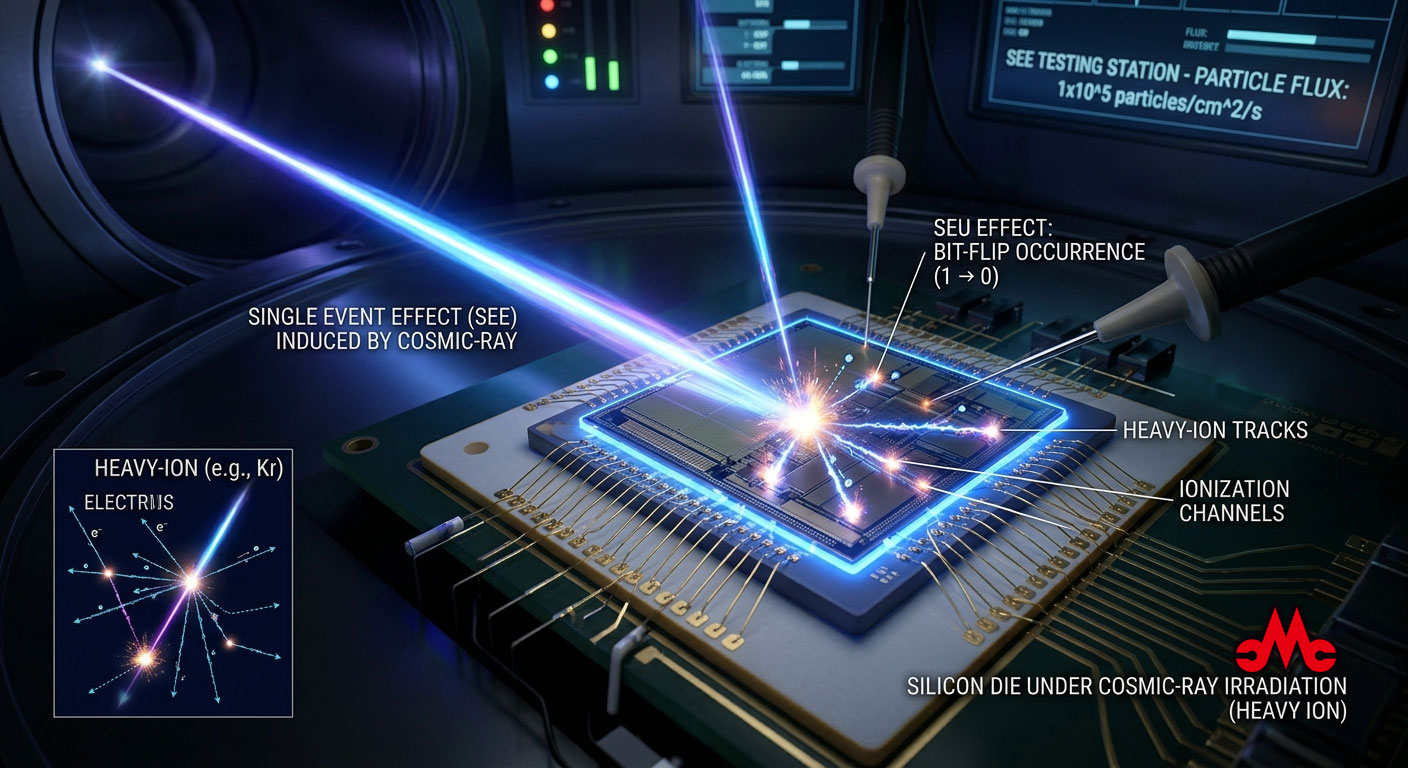
In artificial satellites, high-altitude aircraft, and high-reliability systems, cosmic rays can generate electrical charges inside semiconductors, potentially disrupting circuit operations.
A representative phenomenon is the Single Event Upset (SEU), a type of Single Event Effect (SEE), where bit flips occur in memories and logic circuits. Cosmic ray irradiation testing evaluates these failure rates and verifies the effectiveness of mitigation measures, such as redundant architectures and error-correcting code (ECC) functions. -
Radiation Damage Evaluation of Materials
This process evaluates crystal defect formation and material degradation caused by high-energy particles. It is utilized to develop radiation-resistant materials for use in spacecraft equipment, nuclear fusion reactors, and particle accelerator facilities.
-
Non-Destructive Testing and Imaging
Technologies are being developed to visualize the interior of thick concrete structures and metallic containers using muon-based imaging and tomography technologies or artificially generated high-energy particles. This method is increasingly applied to non-destructive testing in nuclear facilities and large-scale infrastructure.
Power Supplies Required for Cosmic Ray Irradiation
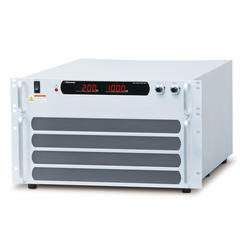
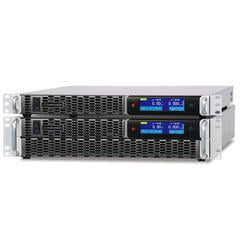
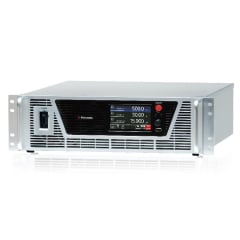
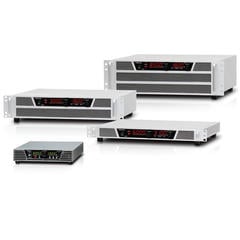
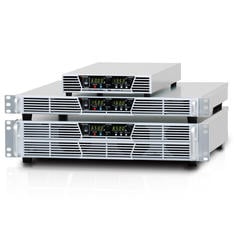
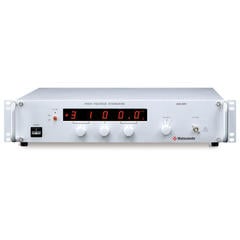
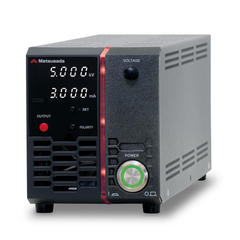
Cosmic ray irradiation facilities utilize a diverse array of high-performance power supplies to drive accelerators, magnets, detectors, and vacuum systems. The stability and control accuracy of these power supplies directly impact beam quality and the reliability of measurement results.
1. High-Voltage Power Supplies for RF Systems
These power supplies are used to drive the RF systems of particle accelerators.
- Required Specifications: High voltage, high power, high stability, and high-repetition-rate operation.
- Applications: Driving RF sources such as klystrons, Inductive Output Tubes (IOTs), and solid-state RF amplifiers.
- Role: Supplying radiofrequency power to RF cavities to impart energy to the particles.
2. High-Stability DC Power Supplies (for Beam Control)
These power supplies drive the electromagnets positioned along the beamline.
- Required Specifications: Low ripple, high stability, and high-precision current control.
- Applications: Excitation of dipole magnets, quadrupole magnets, and steering magnets.
- Role: Controlling the trajectory and focusing of particle beams. Since even minuscule fluctuations in the magnetic field can alter the beam position or beam diameter, extremely high current stability is required.
3. Power Supplies for Detectors and Peripheral Equipment
These power supplies are used to acquire test results with high precision.
- High-Voltage Power Supplies for Detectors: Supplying highly stable high voltage to devices such as:
- Photomultiplier Tubes (PMTs)
- Microchannel Plates (MCPs)
- Radiation detectors
- Power Supplies for Vacuum Systems:
- Driving vacuum pumps and related equipment to maintain an ultra-high vacuum state inside the accelerator.
- Power Supplies for Heating and Temperature Control:
- Supplying power to heaters and temperature controllers to evaluate test samples under high- or low-temperature environments.
- Related Terms:
-
- Cosmic rays
- Particle accelerators
- Radiation hardness
- Radiation resistance
- Soft error
- Single-event effect (SEE)
- Beam control
- Electromagnets
- Radio frequency (RF) accelerators
- Neutrons
- Heavy ions