
What Are Cellulose Nanofibers (CNFs)?
Cellulose nanofibers (CNFs) are next-generation biomass materials produced by mechanically fibrillating cellulose derived from plant-based resources such as wood into nanoscale fibers. Owing to their high specific strength, excellent mechanical properties, outstanding thermal dimensional stability, and superior gas barrier performance, CNFs have attracted significant attention for applications in automotive components, electronic materials, packaging, and biomedical devices.
One of the key technologies for maximizing the performance of CNFs in films and polymer composites is fiber alignment control. When individual CNFs are randomly dispersed, their intrinsic properties cannot be fully utilized. By precisely aligning the nanofibers in a preferred direction, the anisotropic properties of the material (including its mechanical strength, thermal dimensional stability, and optical characteristics) can be effectively controlled, enabling the development of high-performance functional materials.
Electric-field-assisted Alignment of CNFs
Various techniques have been developed to control the orientation of cellulose nanofibers, including methods based on shear flow and extensional flow. Among them, electric-field-assisted alignment combined with fluidic control has attracted considerable attention as a non-contact technique capable of achieving highly uniform fiber orientation while remaining compatible with continuous manufacturing processes.
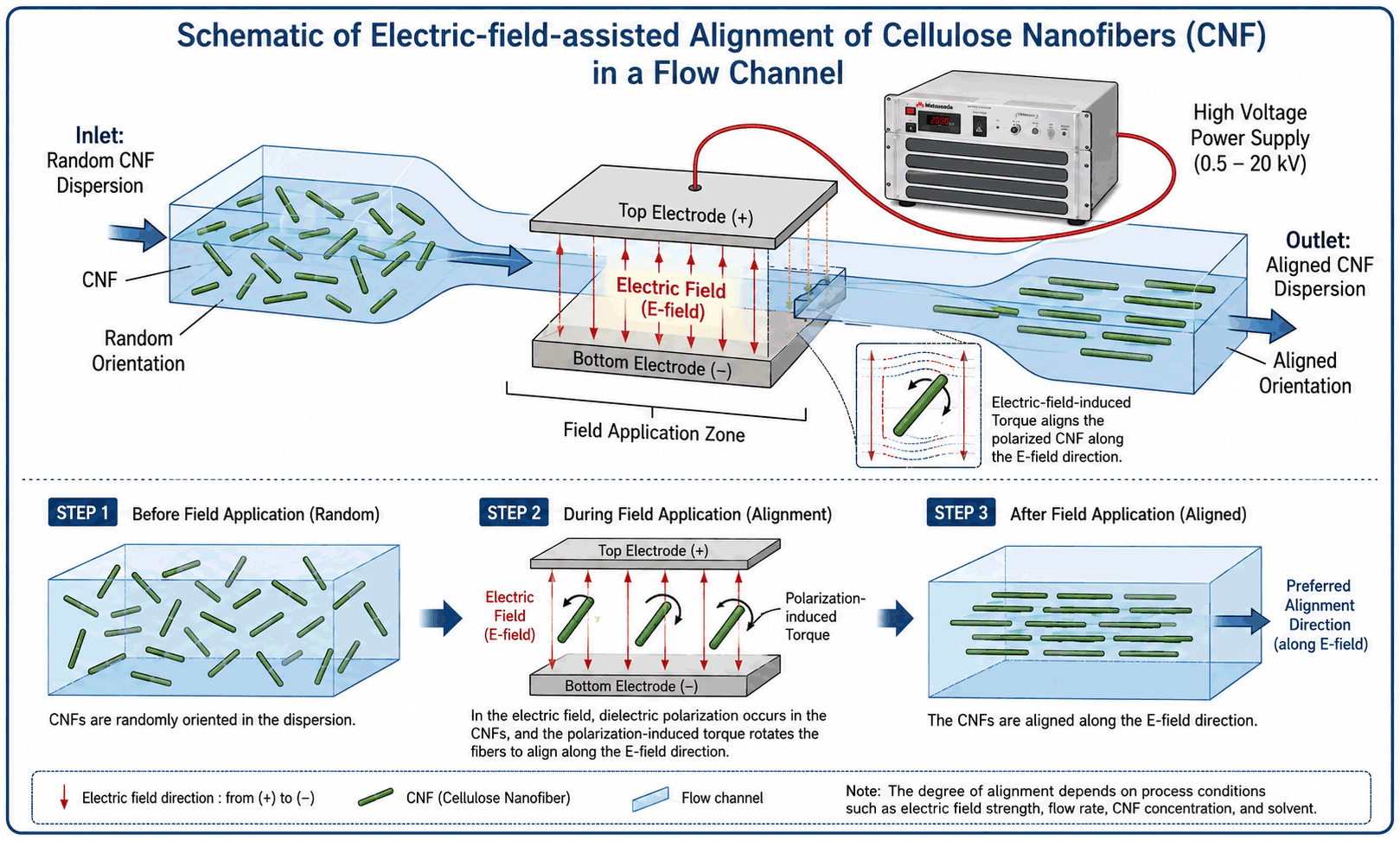
In a representative process, a CNF dispersion is introduced into a microchannel with a gradually decreasing cross-sectional area. As the suspension passes through the converging channel, the extensional flow field gently pre-aligns the individual nanofibers along the flow direction.
A high-voltage electric field (typically an AC or pulsed electric field) is then applied across electrodes positioned around the microchannel. Under the applied electric field, the CNFs become dielectrically polarized. The resulting polarization-induced torque rotates the nanofibers, causing them to align more precisely along the electric field axis. Depending on the electrode geometry and electric field distribution, additional electrokinetic effects, such as dielectrophoresis, may also contribute to the alignment behavior.
By combining hydrodynamic pre-alignment with electric-field-assisted orientation, this approach enables highly uniform and well-controlled fiber alignment. Furthermore, because the process can be readily integrated into continuous flow systems, it is considered a promising technology for scalable manufacturing, including roll-to-roll continuous film production.
High-voltage Power Supply Requirements for Electric-field-assisted Alignment
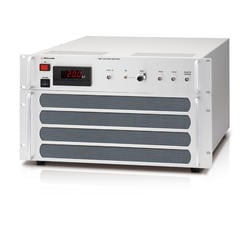
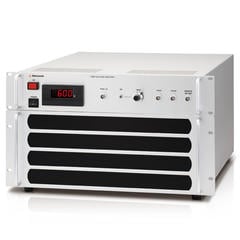
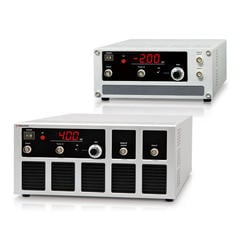
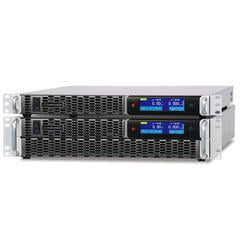
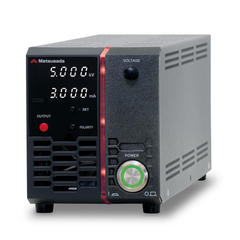
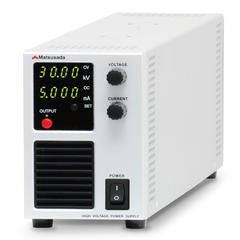
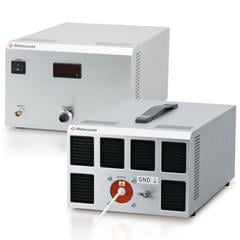
In electric-field-assisted CNF alignment, the quality and stability of the applied electric field have a direct impact on the alignment quality. Consequently, the performance of the high-voltage power supply plays a critical role in achieving consistent and reproducible results.
-
Excellent Output Stability
Variations in electric field strength can lead to non-uniform fiber orientation. Maintaining a stable electric field therefore requires a high-voltage power supply with exceptionally low ripple and noise, as well as excellent long-term output stability.
-
Precise Voltage and Frequency Control
The optimum alignment conditions depend on various process parameters, including CNF concentration, solvent dielectric properties, electrical conductivity, flow rate, and channel geometry. In processes using AC or pulsed electric fields, not only the output voltage but also the frequency and waveform significantly influence alignment performance. Therefore, the power supply should provide high-resolution voltage setting together with precise frequency and waveform control.
-
Fast and Repeatable Response
During research and process optimization, electric field conditions are often adjusted repeatedly to determine the optimum operating parameters. A high-voltage power supply capable of fast, stable, and repeatable output control improves both experimental efficiency and process reproducibility.
Supporting Advanced CNF Manufacturing with High-voltage Power Supplies
High-voltage power supplies are a key component in electric-field-assisted CNF alignment systems, providing the stable and uniform electric fields required for precise fiber orientation. Power supplies offering low-noise output, excellent stability, and highly accurate voltage and frequency control support applications ranging from laboratory-scale research and process development to future high-volume manufacturing.
- Related Terms:
-
- Cellulose Nanofiber (CNF)
- Electric-field-assisted Alignment
- Fiber Alignment Control
- Flow-channel Process
- AC Electric Field, Individual CNFs
- Electrospinning (formation of ultra-fine polymer fibers)