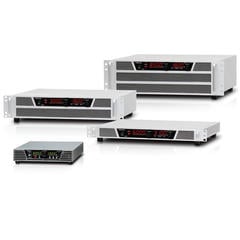

Capacitor testing evaluates the performance and reliability of capacitors through various critical measurements. These tests, often defined by standards such as JIS C 5101-1:2019 and IEC 60384-1:2016, include dielectric withstand voltage, leakage current measurement, and breakdown (destructive) testing.
Dielectric Withstand Voltage Test:
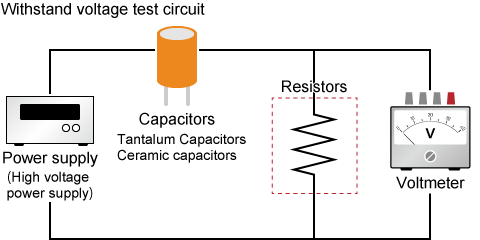
Commonly conducted on tantalum and ceramic capacitors, this test applies a voltage 1.5 to 2 times the rated voltage to ensure insulation reliability. It requires a high-voltage power supply capable of delivering stable output well beyond standard operating voltages.
Leakage Current Measurement:
This test measures the minute current flowing through the capacitor when a specified high voltage is applied. High-precision power supplies are essential for detecting these subtle currents accurately.
Destructive (Breakdown) Test:
This involves increasing the voltage until the capacitor fails, determining its breakdown limit. Since failure often results in a short circuit and a rapid current surge, the power supply must react instantly. Matsusada Precision offers models with fast-response overcurrent protection (OCP) to safely cut the output, protecting the testing equipment and ensuring operator safety.
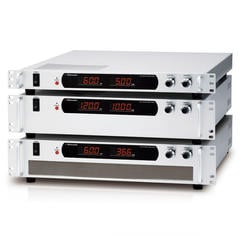
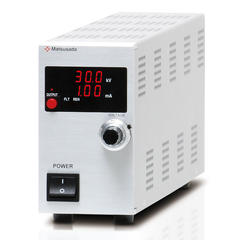
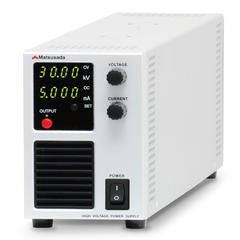
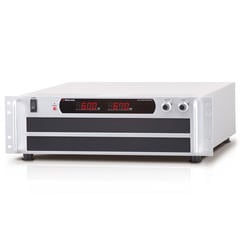
We provide a wide range of high-voltage power supplies optimized for these demanding capacitor testing applications.
Withstand voltage test circuit
- Related Terms:
-
- Electrolytic capacitors
- Ceramic capacitors
- Film capacitors
- Withstand voltage test
- Leakage current
- Destructive test
- Overcurrent
- High voltage
- Capacitor Charging
Recommended products
Matsusada Precision has models with a protection function that cuts off the output in case of overcurrent. We handle high-voltage power supplies, which are available for various types of capacitor testing as well as destructive testing.