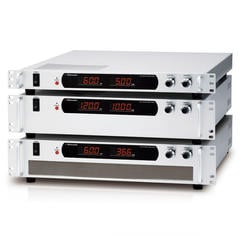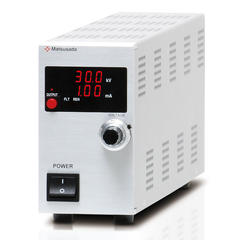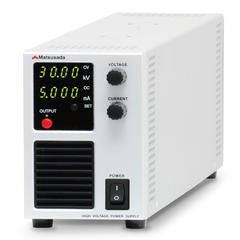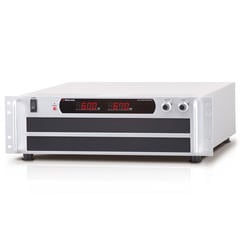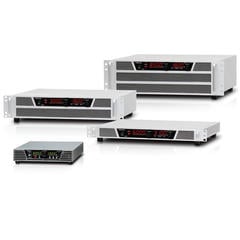

Capacitor testing involves measuring the performance of capacitors through various evaluations. These tests, specified in standards such as JIS C 5101-1:2019 and IEC 60384-1:2016, include the dielectric withstand test, leakage current measurement, and destructive tests.
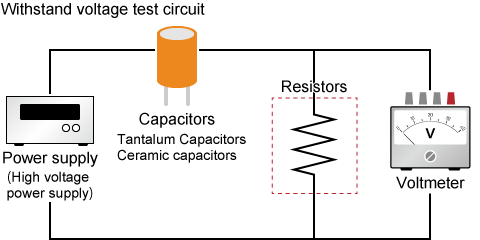
Withstand voltage tests are commonly conducted on tantalum and ceramic capacitors. To ensure reliability, these tests apply a voltage 1.5 to 2 times the capacitor's rated voltage. This process requires a high-voltage power supply capable of delivering voltages beyond those of standard power supplies.
The leakage current measurement test determines the amount of current that flows when a specified voltage is applied. This is done by applying a high voltage with a power supply and measuring the resulting leakage current.
A destructive test involves applying a progressively higher-than-rated voltage to a capacitor to determine the voltage at which it fails. When a capacitor fails, it can create a short circuit, causing a dangerous overcurrent condition. To address this, Matsusada Precision offers models with a built-in protection function that automatically cuts off the output during an overcurrent event.
We offer a wide range of high-voltage power supplies suitable for all types of capacitor testing, including destructive tests.
Withstand voltage test circuit
- Related Terms:
-
- Electrolytic capacitors
- Ceramic capacitors
- Film capacitors
- Withstand voltage test
- Leakage current
- Destructive test
- Overcurrent
- High voltage
- Capacitor Charging
Recommended products
Matsusada Precision has models with a protection function that cuts off the output in case of overcurrent. We handle high-voltage power supplies, which are available for various types of capacitor testing as well as destructive testing.