
An Avalanche Photodiode (APD) is a high-sensitivity photodetector ideal for low-light applications. By applying a high reverse bias voltage, APDs utilize an internal gain mechanism known as avalanche multiplication. This process amplifies the signal, enabling the detection of weak light signals with significantly higher sensitivity than standard photodiodes.
Features of Matsusada's APDs
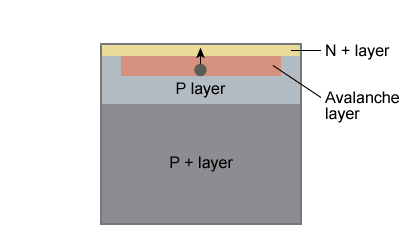
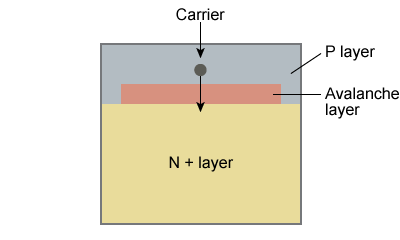
A key advantage of Matsusada Precision's APDs is the use of a P-incidence structure, unlike the conventional N-incidence structure found in most devices. In N-incidence structures, charge carriers generated by short-wavelength light near the surface may fall outside the multiplication region, resulting in reduced sensitivity.
In contrast, Matsusada Precision's P-incidence structure efficiently guides carriers generated near the surface into the avalanche layer. Combined with advanced crystal growth technology that minimizes lattice defects, this design ensures low-noise performance. Additionally, the stable P-layer formation minimizes variations in breakdown voltage between devices.
APD sensor product page (Japanese site)
Example of Avalanche Photodiode (APD) Circuit
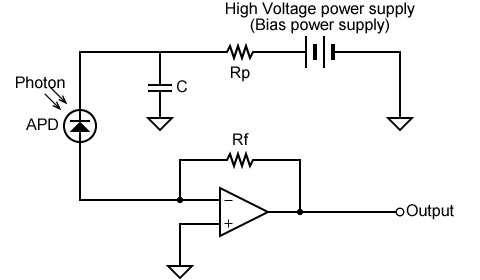
The diagram illustrates a typical photon counting circuit utilizing an APD. A high reverse bias voltage (typically up to 300 V) is applied to the device. Because maximum voltage ratings vary by model, always verify the specifications of the specific APD to ensure the applied voltage remains within safe limits. A current-limiting resistor is recommended for protection.
Incident photons generate a current flow, which is converted into a voltage signal by a transimpedance amplifier (current-to-voltage converter) using a high-speed operational amplifier.
- Related Terms:
-
- Photodiode
- PIN Photodiode
- Photomultiplier Tubes (PMT)
- Photodetector
- Hybrid Photodetector
- Flat Panel Detector (FPD)