


What is SIMS (Secondary Ion Mass Spectrometry)?
SIMS (Secondary Ion Mass Spectrometry) is an analytical technique used to measure the elemental composition and depth distribution of a sample surface with extremely high sensitivity. SIMS achieves this by bombarding the sample surface with an accelerated primary ion beam and mass-analyzing the secondary ions emitted from the surface.
One of the defining features of SIMS is its exceptional sensitivity. It can detect trace elements at the ppb (parts per billion) level and, under optimized conditions, even at the ppt (parts per trillion) level. This level of sensitivity is difficult to achieve with many other analytical techniques, making SIMS an indispensable tool in materials science, semiconductor development, and advanced materials research.
Furthermore, by continuously sputtering the sample surface during measurement, SIMS can provide elemental concentration profiles from the surface into the bulk material with excellent depth resolution.
Principle of SIMS
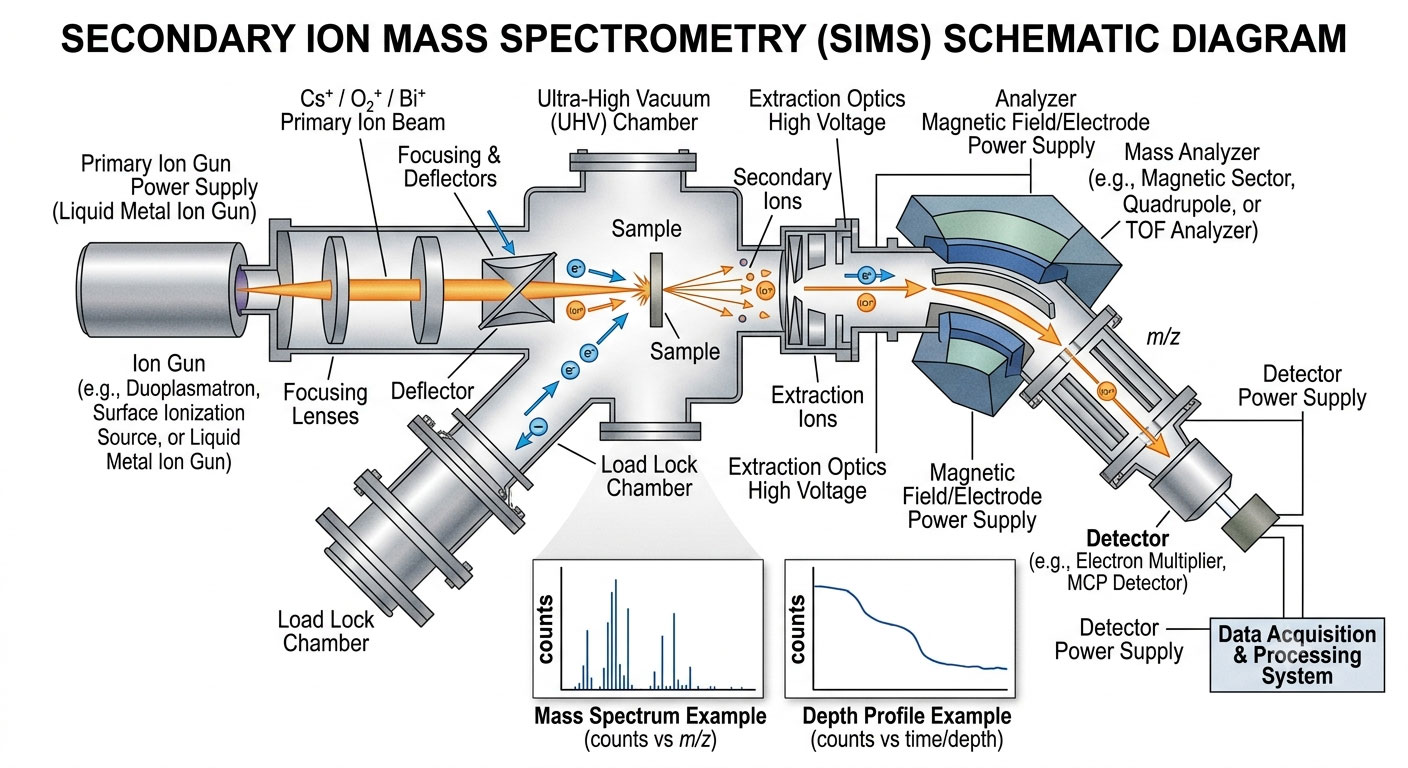
SIMS measurement is broadly divided into the following three steps:
-
Sputtering (Emission)
Accelerated primary ions (such as Cs⁺, O₂⁺, and Bi⁺) are directed onto the sample surface, ejecting atoms and molecules through sputtering. During this process, a fraction of the emitted particles become ionized. These ions are referred to as secondary ions.
-
Mass Analysis (Separation)
The emitted secondary ions are guided into a mass analyzer, such as a magnetic sector, quadrupole, or time-of-flight (TOF) analyzer, where they are separated according to their mass-to-charge ratio (m/z). This enables identification of the elements and chemical species present in the sample.
-
Detection (Measurement)
The separated ions are detected using devices such as microchannel plates (MCPs) or electron multipliers. By continuously sputtering with the primary ion beam, elemental distributions as a function of depth (depth profiles) can be obtained.
Applications of SIMS
Leveraging its ultra-high sensitivity, SIMS is widely used in advanced analytical applications, including:
-
Semiconductor Device Development
Measurement of dopant concentration profiles (e.g., boron, phosphorus, and arsenic) and trace impurity analysis in silicon wafers.
-
Thin Film and Interface Analysis
Evaluation of interface sharpness in multilayer structures, diffusion analysis, and elemental distribution measurements throughout thin-film layers.
-
Battery Materials Analysis
Analysis of lithium distribution and degradation mechanisms within lithium-ion batteries and other advanced energy storage devices.
-
Advanced Materials Research
Trace impurity analysis on catalyst surfaces, evaluation of compositional changes, and research and development of functional materials.
Power Supplies Required for SIMS
A SIMS system incorporates numerous high-voltage and precision power supplies. Because power supply performance directly affects analytical sensitivity, mass resolution, and depth resolution, extremely high stability and low-noise characteristics are essential.
1. Primary Ion Source: High-Voltage Power Supply (Several kV to Tens of kV)
Used to accelerate primary ions and generate a stable ion beam.
- Required Specifications
-
- Ultra-low ripple
- Low noise
- Excellent long-term stability
- Impact on Measurement
-
Voltage fluctuations cause variations in ion beam energy, resulting in changes in sputtering rates and increased measurement noise.
2. Mass Analyzer Section: Precision Voltage Power Supply (Several Hundred Volts to Several kV)
Used for electrostatic lenses, deflection electrodes, energy analyzers, and related components.
- Required Specifications
-
- High-precision voltage regulation
- Excellent long-term stability
- Low temperature drift
- Impact on Measurement
-
Even slight voltage fluctuations can alter ion trajectories, causing degradation of mass resolution and peak position shifts.
3. Sample Bias: High-Stability Power Supply
Applies a bias voltage to the sample to control the extraction efficiency and energy distribution of secondary ions.
- Required Specifications
- High stability
- Low ripple
- High output accuracy
- Impact on Measurement
-
Instability in the sample bias voltage can reduce sensitivity and degrade mass resolution.
4. Detector: High-Voltage Power Supply
Used to operate detectors such as microchannel plates (MCPs) and electron multipliers.
- Required Specifications
- Low noise
- High stability
- High reliability
- Impact on Measurement
-
Power supply noise can increase signal fluctuations and reduce detection sensitivity for trace elements.
5. Charge Neutralization: Filament Power Supply
When analyzing insulating materials, surface charging (charge-up) can occur. An electron flood gun or similar device is used to supply electrons and neutralize accumulated charge.
- Required Specifications
- Stable filament heating
- High-precision current control
- High reliability
- Impact on Measurement
-
Insufficient charge neutralization can alter secondary ion yields, reducing measurement reproducibility and quantitative accuracy.
Summary: Power Supply Quality Directly Impacts SIMS Performance
In SIMS systems, power supplies are far more than simple sources of electrical power. Their performance directly influences analytical sensitivity, mass resolution, and depth resolution.
High-stability, low-noise power supplies play a critical role in maintaining ion beam stability, improving mass analysis performance, and enabling highly sensitive detection of trace elements.
We provide high-stability, low-noise power supply solutions optimized for SIMS systems and other analytical and vacuum equipment applications.
- Related Terms:
-
- Secondary Ion Mass Spectrometry (SIMS)
- Depth Profiling
- Dopant Analysis
- Surface Analysis
- Mass Spectrometry
- Ion Beam