

Maximizing the performance of high-power RF amplification through advanced, high-precision power control technology.
What is a Klystron?
A klystron is a specialized vacuum tube that amplifies radio frequency (RF) signals through the interaction between an electron beam and resonant cavities.
Because it achieves extraordinarily high output power levels that are unattainable with conventional solid-state semiconductor amplifiers (such as standard transistors), the klystron remains an indispensable device as a high-power RF source.
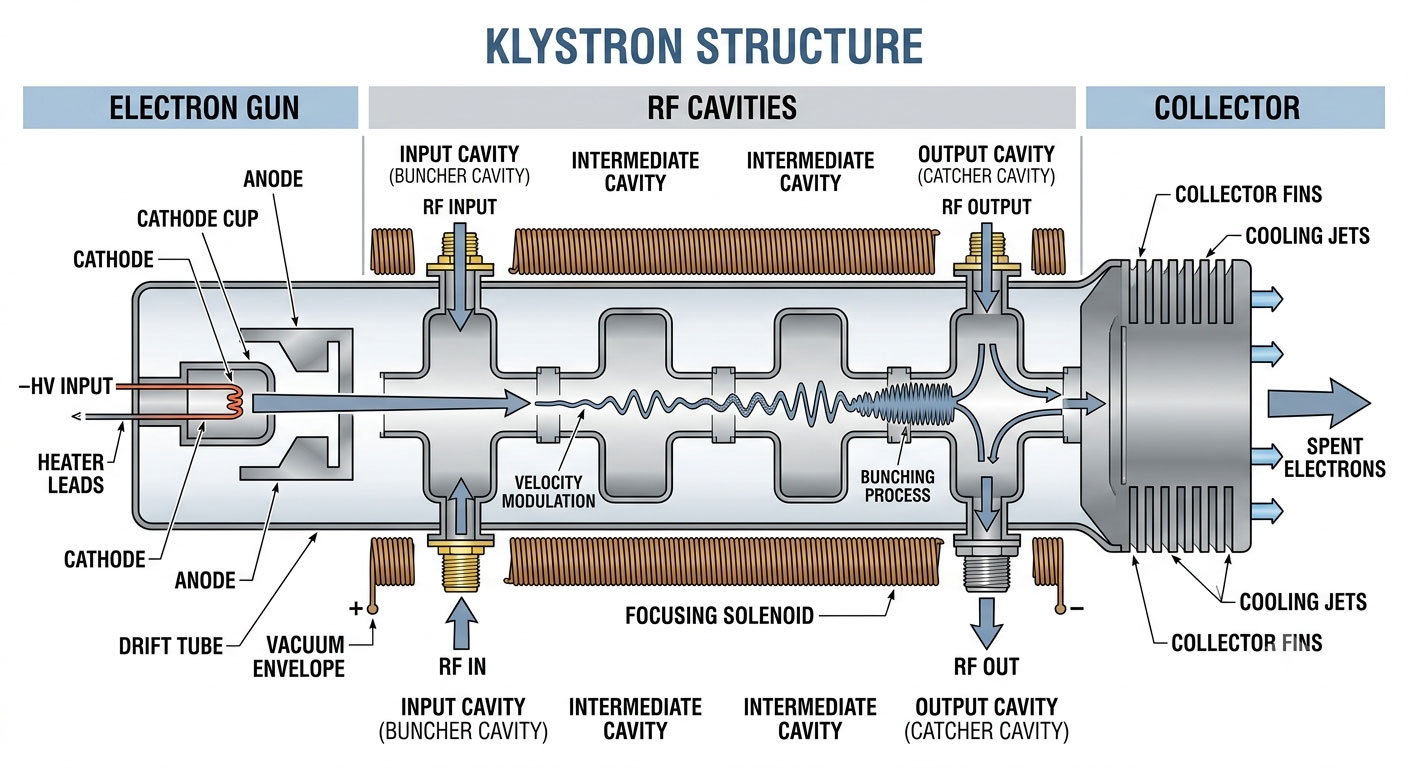
Structurally, it consists of an electron gun to emit electrons, cavity resonators to control the electron flow, and a focusing magnet system to guide the beam straight through the structure.
Operating Principle of a Klystron
Klystrons amplify RF signals through a sequence of processes known as "velocity modulation" and "density modulation":
-
Electron Beam Generation:
A high-velocity electron beam is emitted from the cathode within the electron gun.
-
Velocity Modulation (Buncher Cavity):
As the beam passes through the buncher cavity, the alternating voltage of the input RF signal causes the electrons to repeatedly accelerate and decelerate.
-
Density Modulation (Bunching):
As the accelerated electrons catch up with the slower-moving electrons ahead of them, the continuous beam transforms into a series of distinct clusters or "bunches"
-
Energy Conversion (Catcher Cavity):
When these tightly bunched electrons pass through the catcher cavity, their kinetic energy is transferred and converted into high-power RF energy, producing a highly amplified RF output.
Throughout this entire process, a precise focusing magnetic field is essential to guide and contain the electron beam, preventing it from dispersing.
Key Applications
Klystrons are widely utilized across cutting-edge scientific research and critical communication infrastructures that demand ultra-high-power RF signals:
-
Particle Accelerators:
Used as the primary RF drive source to accelerate particles to extreme energy levels in particle physics research installations and medical linear accelerators (linacs).
-
High-Power Radar Systems:
Deployed in the transmitter stages of military/defense and meteorological radars for long-range object detection.
-
Broadcasting & Communications:
Utilized in high-power UHF television transmitters and as high-power amplifiers (HPAs) in large-scale satellite earth stations that uplink signals from Earth into deep space.
Power Supply Requirements for Klystron Systems
A klystron system is a highly sophisticated apparatus that integrates high-voltage, high-frequency, and ultra-high-vacuum technologies. Because multiple power supply subsystems must operate in perfect, synchronized harmony, the overall quality and stability of these power supplies directly dictate the accuracy and performance of the RF output.
1. High-Voltage Power Supply (Main Power Supply)
The most critical power source in the system, responsible for applying a high potential to the cathode of the electron gun to accelerate the electrons.
- Voltage Range: Typically 10 kV to 50 kV for standard communications; exceeding 300 kV for specialized particle accelerators.
- Required Characteristics: Extremely high stability and ultra-low ripple are mandatory.
- Ultra-Fast Protection: If internal arcing (electrical discharge) occurs within the vacuum tube, the power supply may need to shut down within a few microseconds (μs) to prevent catastrophic damage to the device.
2. Filament Power Supply
Heats the cathode to thermionic emission temperatures, allowing it to release free electrons. The filament power supply is typically operated at the same high-voltage potential as the cathode and therefore must be electrically isolated from ground. In addition, to maintain stable electron emission and consistent RF output, the beam current may be monitored and used to regulate the filament power, providing long-term emission stability.
- Characteristics: Requires highly precise control of low-voltage, high-current power (typically several volts at tens of amperes).
3. Solenoid Power Supply
Generates a powerful magnetic field to focus and confine the electron beam, ensuring it travels straight without expanding or hitting the cavity walls.
- Characteristics: Must provide a highly stable, continuous medium-to-high current output (ranging from several amperes to over a hundred amperes).
4. Ion Pump Power Supply (As Required)
Maintains the critical ultra-high-vacuum condition inside the klystron tube during operation.
- Characteristics: Applies a high voltage of several kilovolts (kV) to safely remove residual gas molecules.
Consult Our Experts
Designing and manufacturing power supplies for klystrons represents one of the most demanding challenges for any power supply manufacturer. Because these systems require flawless synchronization among multiple power sub-systems and must possess exceptional resilience against harsh, unpredictable arcing environments, standard off-the-shelf power supplies are completely inadequate.
Leveraging our years of expertise in ultra-fast arc protection circuitry and high-precision voltage regulation, we deliver fully optimized, custom power solutions tailored precisely to your system requirements. We invite you to contact us from the earliest stages of your specification review - our engineering team is ready to assist you.
- Related Terms:
-
- Radar
- vacuum tubes
- electron guns
- cavity resonators
- focusing magnet system