
In Atomic Absorption Spectroscopy (AAS), light source stability is one of the most critical factors affecting measurement accuracy. This page provides an overview of the Hollow Cathode Lamp (HCL), a light source widely used in AAS, and explains the power supply requirements necessary to maximize its performance.
What is a Hollow Cathode Lamp (HCL)?
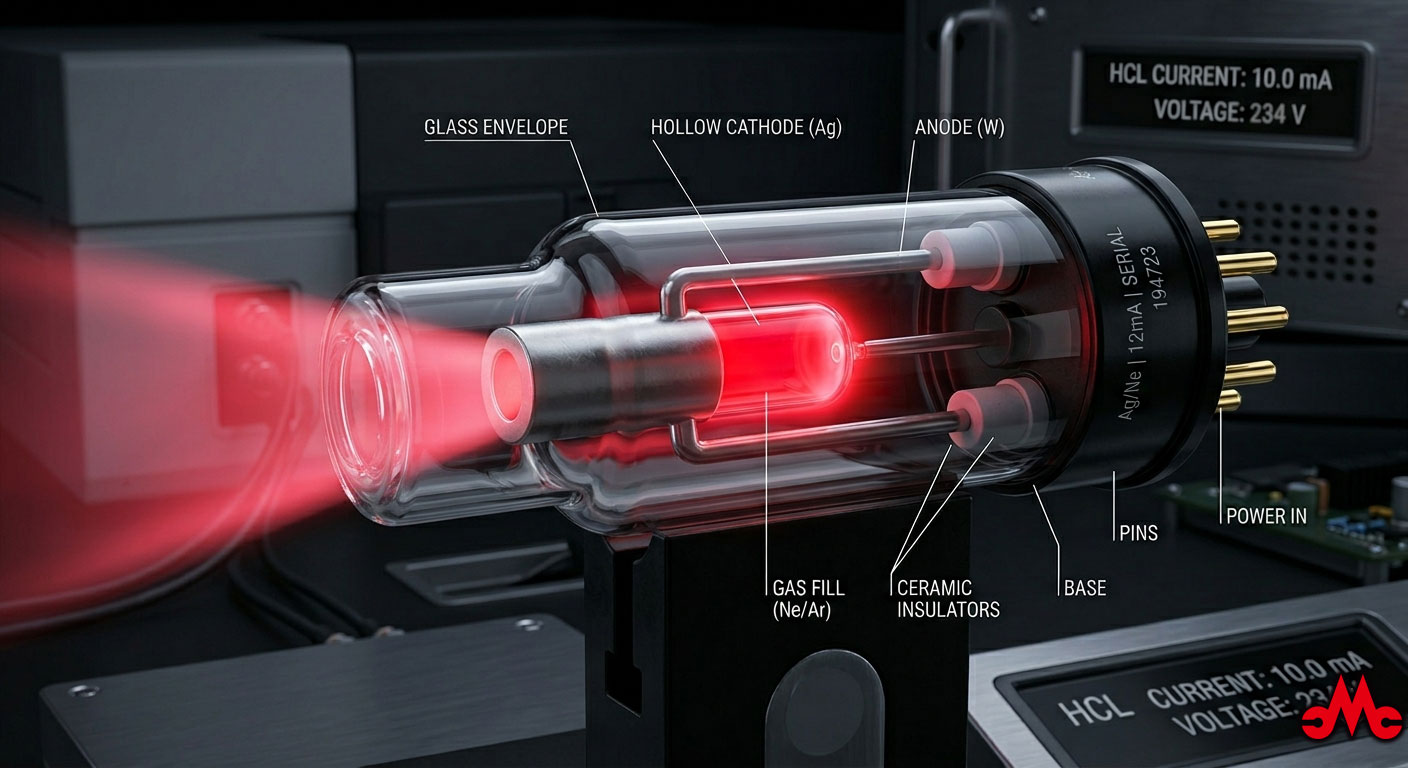
A Hollow Cathode Lamp (HCL) is a specialized light source used in Atomic Absorption Spectroscopy (AAS) to generate the characteristic spectral lines (resonance lines) of the element being analyzed.
In AAS, the sample must be illuminated with spectral lines that closely match the absorption wavelengths of the analyte element. Because an HCL uses the target element itself as the cathode material, it can produce stable, sharp, element-specific spectral lines. This unique characteristic enables AAS to achieve high selectivity and excellent measurement accuracy.
Principle of the Hollow Cathode Lamp (HCL)
An HCL consists of a hollow cathode made from the target element and an anode, both sealed within a glass tube filled with an inert gas such as neon or argon.
Light emission occurs through the following process:
-
Discharge Initiation
When voltage is applied from the power supply, the inert fill gas becomes ionized, initiating a glow discharge.
-
Sputtering
The generated gas ions collide with the cathode surface, ejecting atoms of the target element from the cathode material. This phenomenon is known as sputtering.
-
Excitation and Light Emission
The sputtered atoms become excited through collisions with electrons and ions within the discharge. As these excited atoms return to their ground state, they emit light at wavelengths characteristic of the element.
Through this process, the lamp produces element-specific emission spectra with extremely narrow spectral line widths.
Applications of Hollow Cathode Lamps (HCL)
HCLs are widely used in applications that require trace element analysis.
Environmental Analysis
Measurement of heavy metals such as lead, cadmium, chromium, and mercury in river water, groundwater, and wastewater.
Food and Pharmaceutical Analysis
Quantification of mineral content in food products and residual catalyst-derived metal impurities in pharmaceutical products.
Industrial and Materials Analysis
Composition analysis of metallic materials, quality control, and evaluation of trace impurities in semiconductor materials and electronic components.
Clinical and Research Applications
Analysis of trace metal elements in biological samples such as blood and urine.
In these applications, concentrations are often measured at the ppm (parts per million) or ppb (parts per billion) level. As a result, even small variations in light source output can significantly affect the reliability of measurement results.
Power Supply Considerations for Hollow Cathode Lamps (HCL)
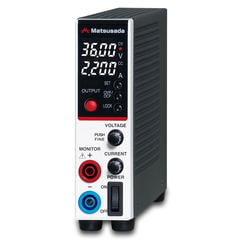
Because the emission intensity of an HCL is highly dependent on lamp current, a high-performance constant-current power supply is essential for stable and reliable measurements.
1. Ultra-Stable Low-Current Output
The operating current of an HCL typically ranges from a few milliamperes to several tens of milliamperes.
Any fluctuation in current directly affects light output, resulting in increased measurement noise and reduced accuracy. Therefore, the power supply must provide highly accurate constant-current regulation with excellent long-term stability.
2. Stable Ignition Control and Sufficient Voltage Headroom
During ignition, the lamp requires a higher voltage than during normal operation.
To ensure reliable lamp startup, the power supply must provide sufficient voltage headroom and stable ignition performance. Smooth transition from ignition to the specified operating current is also important for stable operation.
3. Ultra-Low Ripple and Low-Noise Performance
Small current fluctuations and ripple can appear as variations in light intensity, directly affecting the measurement signal.
Particularly in low-concentration analyses, power-supply-induced noise can degrade the achievable detection limit and measurement repeatability. For this reason, power supplies with extremely low ripple and low-noise characteristics are highly desirable.
4. Contribution to Measurement Stability and Repeatability
Because HCL emission intensity is nearly proportional to lamp current, current fluctuations directly translate into variations in light output.
A power supply with precise constant-current control and low-noise performance helps improve baseline stability, enhance measurement repeatability, and achieve lower detection limits in trace element analysis.
Summary
The Hollow Cathode Lamp is a vital light source used in Atomic Absorption Spectroscopy to generate element-specific emission spectra. Because light source stability directly influences measurement accuracy in trace element analysis, the power supply driving the HCL must provide precise constant-current regulation, low-noise performance, and excellent long-term stability.
By delivering stable current with minimal noise, a high-quality power supply helps maximize analytical instrument performance and supports highly reliable measurement results.
- Related Terms:
-
- Hollow Cathode Lamp
- Atomic Absorption Spectroscopy
- Trace Element Analysis
- Heavy Metal Analysis
- Constant-Current Power Supply
- Emission Spectrum
- Sputtering
- Power Supplies for Analytical Instruments
- Detection Limit
- Measurement Repeatability