
What is Methanation?
Methanation is a process that converts carbon dioxide (CO2) and hydrogen (H2) into methane (CH4).
In recent years, taking action toward achieving "carbon neutrality" has become an urgent global priority to combat global warming. This technology, which captures emitted CO2 and converts it back into fuel (synthetic methane) using hydrogen derived from renewable energy, is drawing significant attention as a powerful solution for supporting decarbonization efforts. The synthetic methane produced through this process is known as "e-methane." Because it is highly compatible with existing gas distribution infrastructure, it can be delivered through existing gas distribution networks.
Principle of Methanation
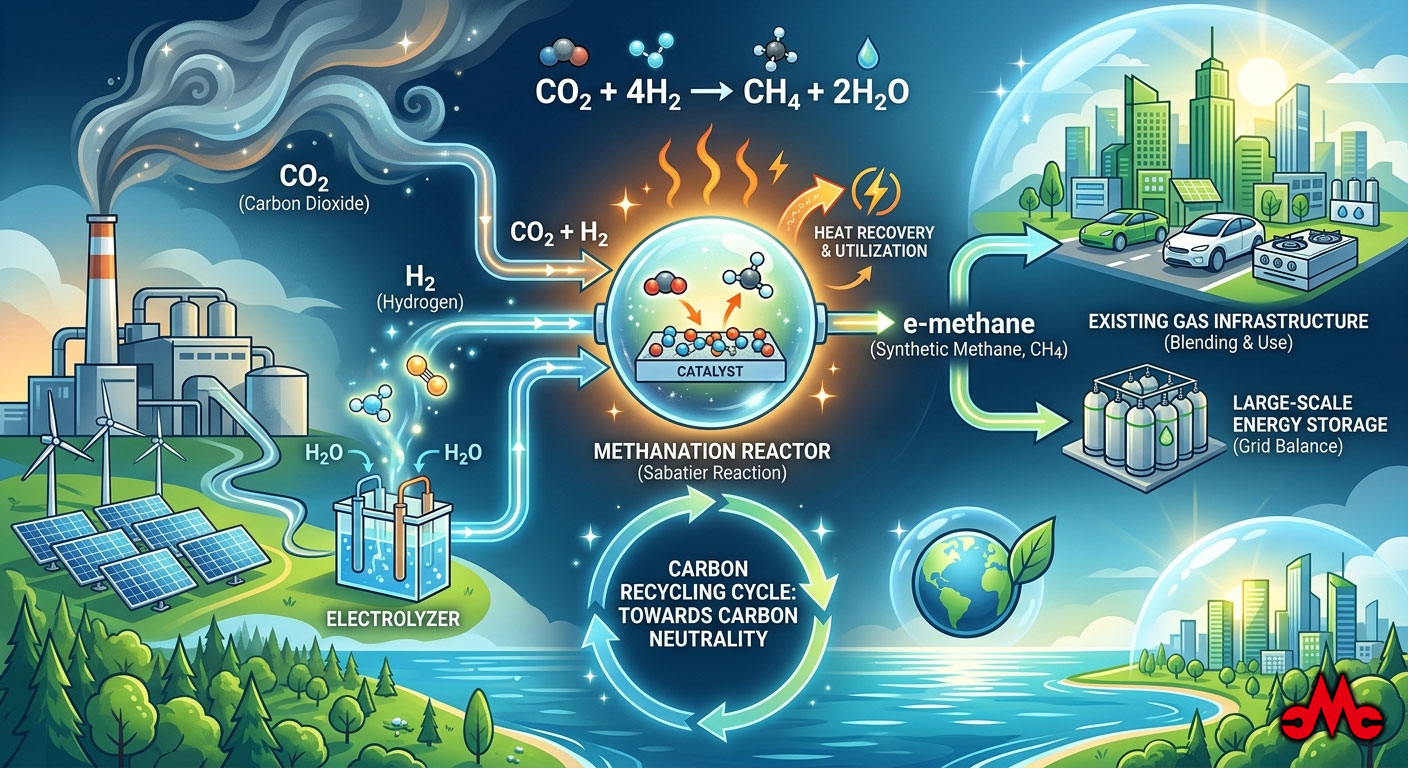
The key reaction underlying methanation is the Sabatier Reaction.
- Chemical Equation
- CO2 + 4H2 → CH4 + 2H2O + Heat
This reaction takes place in the presence of a catalyst (such as nickel or ruthenium). Methane is produced by properly mixing CO2 and hydrogen and allowing them to react under specific temperature and pressure conditions. Although this process is an exothermic reaction, a certain amount of activation energy is required to initiate it. Therefore, precise temperature management is essential to ensure optimal catalyst performance.
Applications of Methanation
Since synthesized methane (e-methane) is chemically identical to conventional natural gas, it can be utilized across a wide range of applications.
- Injection into Existing Gas Networks: Carbon-neutral energy can be supplied using existing gas pipelines and residential appliances, such as household gas stoves and water heaters, without any modifications.
- Industrial Fuel: It can be used as a fuel source for industrial boilers and heating furnaces, contributing to the reduction of CO2 emissions in the manufacturing sector.
- Energy Storage (Power-to-Gas): Electricity generated from renewable energy sources (such as solar or wind power) is stored as hydrogen and then converted into methane. This enables high-capacity, long-term energy storage.
Power Supplies Required for Methanation
The methanation process is a catalytic chemical reaction that relies on high-quality power supplies to ensure stable operation of reactor heating controls, hydrogen production equipment, and various control devices. To guarantee stable system operation and maximize catalyst lifespan, high-quality power supplies tailored to the following applications are indispensable:
1. Reactor Heater Power Supplies
To optimize the catalytic reaction, the reactor must be heated and maintained at a temperature between 200°C and 450°C.
- Required Specifications: Output capacity ranging from several hundred watts to several kilowatts.
- Key Consideration: Since temperature fluctuations affect reaction efficiency and product purity, these power supplies must provide stable output while operating in conjunction with temperature control systems.
2. Hydrogen Production Power Supplies (DC Power Supplies for Electrolysis Systems)
When the feedstock hydrogen is generated through water electrolysis, high-capacity direct current (DC) power supplies are required.
- Alkaline Electrolysis: High-output power supplies capable of delivering large currents, ranging from several kilowatts to megawatt-class systems.
- PEM (Proton Exchange Membrane) Electrolysis: Highly efficient DC power supplies that support operation at high current densities and offer rapid response times.
- Key Consideration: Power supply ripple and stability directly impact electrolysis efficiency and electrode lifespan. Furthermore, utilizing highly efficient DC power supplies reduces energy losses, contributing to lower hydrogen production costs.
3. System Control and Measurement Power Supplies (Industrial Power Supplies)
These power supplies drive control systems such as flow control valves, pressure sensors, and PLCs (Programmable Logic Controllers).
- Required Specifications: Industry-standard voltages such as 24 VDC or 48 VDC.
- Key Consideration: These systems demand high-reliability power supplies with high noise immunity capable of enduring continuous 24/7 operation.
4. Power Supplies for Analytical and Monitoring Equipment
In methanation facilities, various analytical instruments are used to monitor the composition of the reactant gas and the concentration of the generated methane. These instruments require a low-noise, highly stable power supply.
Summary
In methanation facilities, Power supplies play a vital role in ensuring the reliable operation of hydrogen production systems, reactor heating equipment, and plant control systems. By delivering stable and efficient power, they help improve process efficiency, maximize system uptime, and reduce operating costs.
- Related Terms:
-
- Methanation
- e-methane
- Hydrogen Production
- Water Electrolysis
- Power-to-Gas
- DC Power Supply