


Ion Trap Technology and the Role of High Voltage Power Supplies
Ion traps are among the core technologies driving cutting-edge fields of modern physics, including quantum computing and mass spectrometry. These systems require extremely precise electromagnetic fields to confine microscopic charged particles within a localized region in vacuum.
This page explains the fundamentals of ion trap technology, the different types of ion traps, and the critical role of power supplies that directly influence system performance.

1. What Is an Ion Trap?
An ion trap is a technology that confines charged atoms or molecules (ions) within a specific region in vacuum for extended periods using electric and/or magnetic fields.
According to Earnshaw's theorem, static electric fields alone cannot create a stable potential minimum capable of confining charged particles in three-dimensional space. Therefore, dynamic stabilization is achieved using time-varying RF electric fields and magnetic fields. By carefully combining high-frequency RF fields with static magnetic fields, a virtual "cage" for ions can be created.
Because trapped ions are highly isolated from external disturbances, their properties can be measured and manipulated with extremely high precision.
2. Mechanism of the Paul Trap (RF Trap)
A Paul trap (RF trap) confines ions by combining static electric fields (DC) with high-frequency RF electric fields, without requiring magnetic fields. One advantage of this method is that the system can be relatively compact.
Dynamic Confinement by Quadrupole Electric Fields
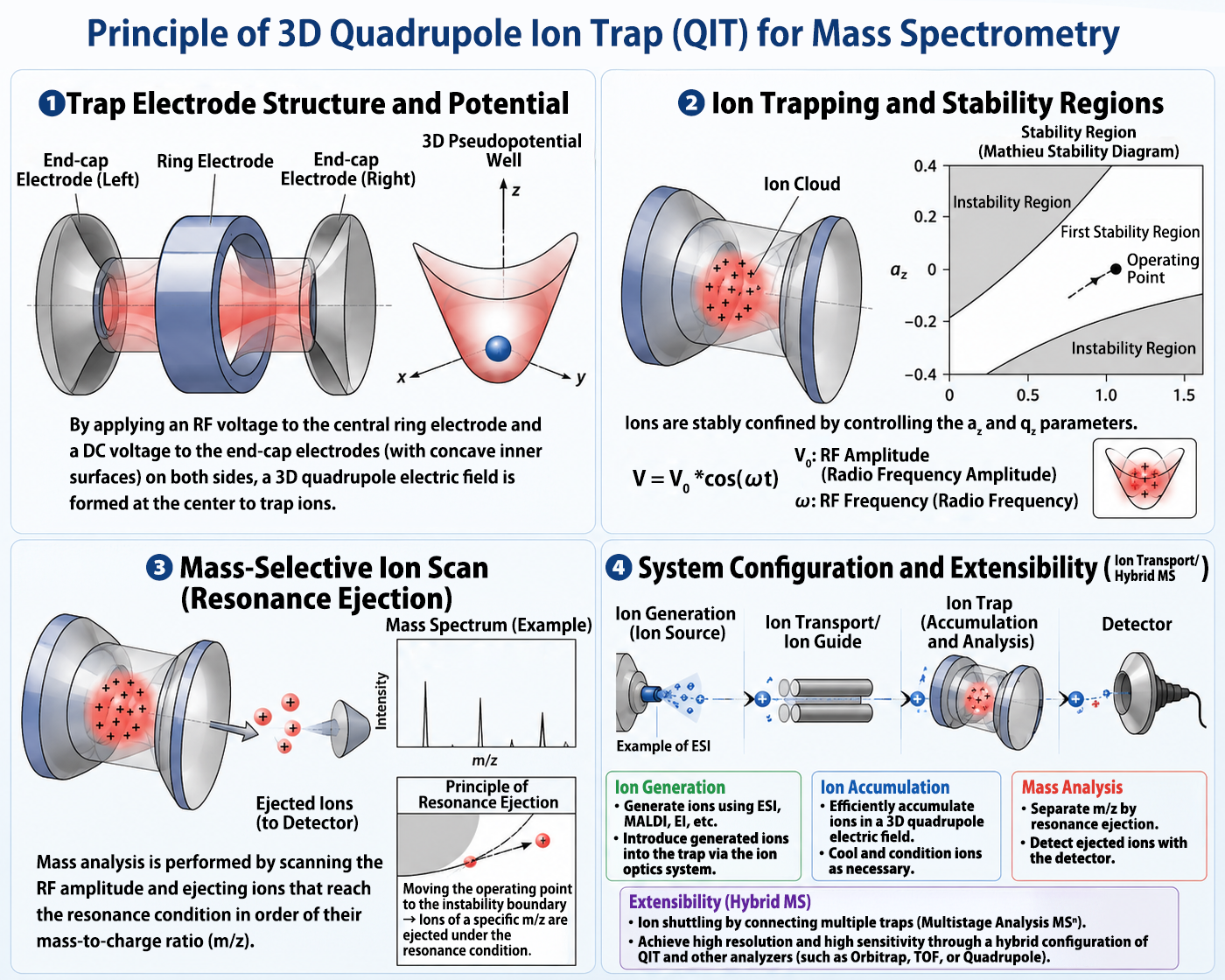
High-frequency voltages with opposite phases are applied to four rod electrodes (linear traps) or ring-shaped electrodes (3D traps). This rapidly alternates the focusing and defocusing directions of the quadrupole electric field near the trap center, forming a time-averaged "pseudo-potential" that confines ions toward the center.
-
3D Quadrupole Trap
A 3D quadrupole trap confines one or a few ions near the center point.
-
Linear Trap
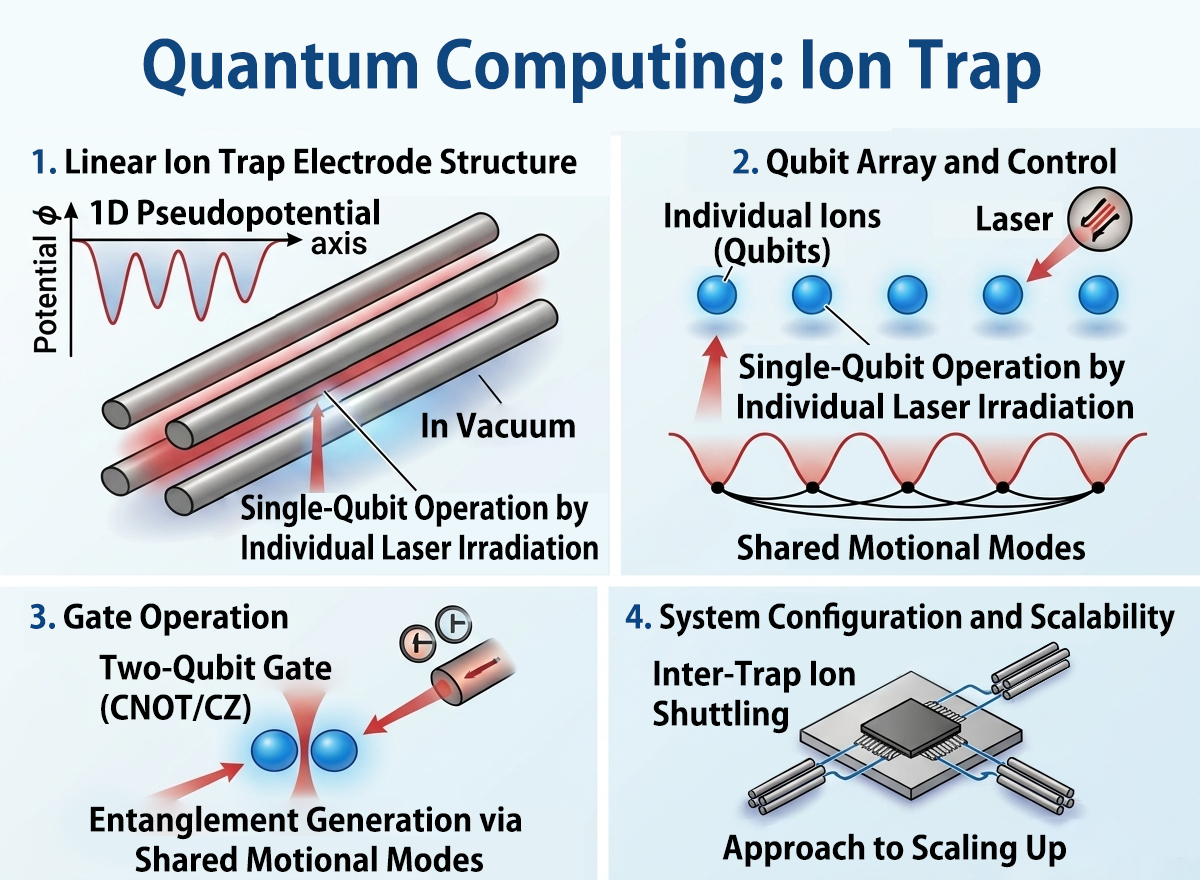
A linear trap uses four rod electrodes to confine ions in a linear chain. Because the arrangement of qubits can be controlled efficiently, linear ion traps are widely adopted as a standard architecture for quantum computers.
3. Major Applications and Use Cases
Quantum Computing
Quantum computing is currently one of the most actively researched applications of ion traps. In Trapped Ion Quantum Computing, trapped ions serve as quantum bits (qubits) and are manipulated using electromagnetic fields and laser systems.
- Trapped Ion Quantum Computing
-
-
High Fidelity:
Since trapped ions are naturally identical particles, they enable highly uniform qubits with minimal device-to-device variation, significantly reducing computational errors.
-
Long Coherence Time:
Suspended ions can be well isolated from external environments such as heat and electromagnetic noise, allowing quantum states to be maintained for remarkably long periods ranging from seconds to minutes.
-
High Connectivity:
Trapped ions interact through collective motional modes, enabling highly accurate quantum gate operations.
-
Scalability Evolution:
Recent developments in trapped-ion quantum computing include QPU (Quantum Processing Unit) chips composed of interconnected linear traps, as well as networked architectures in which ions are transported between multiple traps through ion shuttling.
-
High Fidelity:
Mass Spectrometry
Ion trap technologies are widely used in mass spectrometers such as Quadrupole Ion Traps (QIT), Linear Ion Traps, FT-ICR systems, and Orbitrap analyzers. These technologies are indispensable in pharmaceutical, chemical, and environmental analysis fields.
For more information on mass spectrometry, please refer to the "Mass Spectrometry (MS)" applications section.
Atomic Clocks (Optical Lattice Clocks)
By using ion resonance frequencies as time references, ion-trap-based atomic clocks achieve ultra-high precision equivalent to an error of approximately one second over billions of years.
Fundamental Physics Experiments
Ion traps are also used in antimatter research, ultra-trace isotope analysis, and other advanced physics experiments.
4. Penning Trap
A Penning trap confines ions using a combination of a uniform static magnetic field and a static electric field (DC).
Because strong magnetic fields are utilized, Penning traps are suitable for trapping heavy ions and performing extremely high-precision mass measurements based on cyclotron motion. They are widely used in particle physics experiments such as those conducted at CERN and in Fourier Transform Ion Cyclotron Resonance Mass Spectrometry (FT-ICR MS).
5. Required Power Supplies and Performance Requirements for Ion Traps
The overall performance of an ion trap system including ion lifetime, control precision, and measurement resolution depends heavily on the quality of the applied voltages.
(1) Ultra-Low Noise, Highly Stable DC Power Supplies
Static voltages (DC bias) are used to determine the depth and position of the trapping potential.
-
Importance
Voltage ripple and noise can cause ion heating, ion loss from the trap, and decoherence (collapse of quantum states). Even voltage fluctuations in the µV to mV range may induce motional heating or reduce laser cooling efficiency.
-
Required Performance
ppm-level stability, Extremely low output noise
(2) RF High Voltage Power Supplies
In Paul traps, RF high voltage power supplies generate the dynamic potential walls required for ion confinement.
-
Importance
In general, high voltages ranging from several hundred volts to several kilovolts must be applied accurately at frequencies from hundreds of kHz to tens of MHz.
In quantum computing systems, RF signals in the MHz range are typically amplified using resonant circuits to provide stable RF amplitudes from tens to hundreds of volts. Even slight amplitude fluctuations can directly affect trap stability. -
Required Performance
High frequency stability, Strong drive capability against load fluctuations
(3) High-Speed Switching Power Supplies (for Ion Shuttling)
Particularly in quantum computing systems, electrode voltages must be switched rapidly and precisely in order to transport ions within the trap (ion shuttling) or form specific quantum gate operations.
Ion shuttling refers to a technique in which the DC voltages applied to electrodes are dynamically controlled to move the trapping potential well, thereby transporting ions within the trap.
-
Required Performance
High slew rate (fast rise/fall time), Accurate waveform control without overshoot
Conclusion
Ion trap technology enables extreme atomic-level control, but its success fundamentally depends on the stability of the electromagnetic fields. No matter how advanced the theoretical design may be, unstable power supplies can prevent successful operation.
We provide ultra-low-noise, highly stable high voltage power supply solutions designed to meet the demanding requirements of ion trap experiments.
- Related Keywords:
-
- Ion Trap
- Quantum Computing
- Mass Spectrometry
- Quadrupole Ion Trap
- Paul Trap
- RF Trap
- Linear Trap
- Penning Trap
- Ion Shuttling