


Published: , Modified: T.N.
"Matsusada Precision was the only choice for the precise voltage adjustment required in our flying car experiments."
Case Study: Nozaki Laboratory, Department of System Design Engineering, Faculty of Science and Technology, Keio University
The Nozaki Laboratory at Keio University's Faculty of Science and Technology is developing a quiet, high-speed, propeller-less "Flying Car" powered by ion wind. To achieve this, the team is establishing new propulsion principles utilizing high-voltage phenomena and constructing experimental vehicles. For this critical research, the lab has adopted Matsusada Precision's HAR series (AU series) high-voltage power supplies. We spoke with Associate Professor Takahiro Nozaki, Ph.D., to learn more.
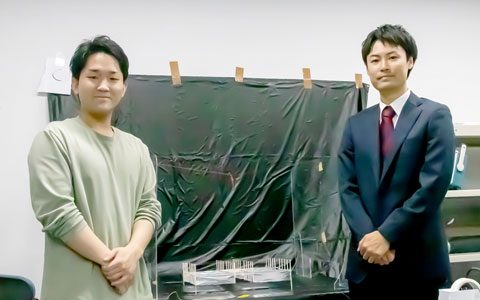
Nozaki Laboratory: Pioneering Power Flow Control and System Creation
Please introduce the Nozaki Laboratory.
Specific research themes include:
- Electric Flying Car: Developing a silent, high-speed, propeller-less aircraft utilizing ion wind propulsion.
- Wireless Power Transfer: Investigating magnetic resonance methods utilizing electrical resonance between transmitting and receiving coils.
- Contact Force Control: Creating flexible robot controls to ensure safety during human interaction.
- Multifunctional Sensors: Enabling robots to manipulate diverse objects.
- Sensorless Motor Control: Driving motors by estimating angles based on current values and mathematical models.
In the medical field, we are developing robots to support remote surgery and studying detection methods for bone penetration in dental implant procedures.

Department of System Design Engineering
Associate Professor Takahiro Nozaki, Ph.D.
The lab's motto is, "Memories for the University! Leave your footprints in the world!" We hope our students enjoy their research, bond with their peers, and have a rewarding experience. In addition to achieving world-class results, students learn system design methodology, consisting of modeling, analysis, and synthesis.
[Usage situation] High-voltage power supplies for "Flying Car" development
Please describe your research using the HAR series (AU series).
We are working to establish new propulsion principles using high voltage, such as ion wind and plasma jets, to construct experimental aircraft.
Ionic wind is an airflow produced when voltage is applied between electrodes, accelerating ionized molecules via the electric field. Because it eliminates the need for fast-moving parts like propellers, it is expected to provide a quiet and robust propulsion mechanism for practical use.
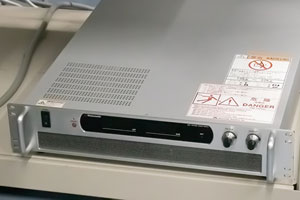
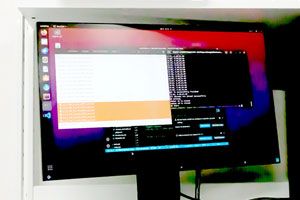
Currently, the HAR series (AU series) is used to apply voltages of approximately 20 kV to 40 kV between aluminum foil electrodes. We have developed a custom control program to adjust the voltage remotely and automatically. This setup allows us to investigate the optimal electrode geometry, electrode gap, and voltage combinations to generate stable ionic wind.
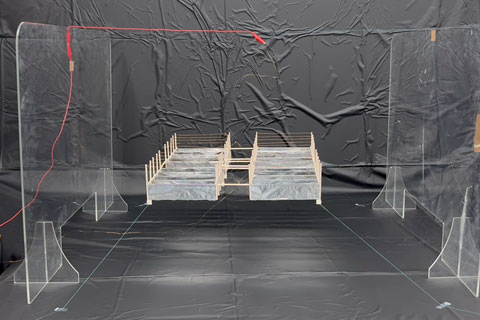
The higher the voltage, the stronger the ionic wind would be generated.
That is true, but as the voltage increases, the air can cause dielectric breakdown and a short circuit. Therefore, it is necessary to identify the maximum voltage that can be applied right before a short circuit occurs.
[Why Matsusada?] Only Matsusada Precision offered the necessary fine voltage control.
Why did you choose the HAR series (AU series)?
For our experiments, we required a high-voltage power supply capable of extremely fine voltage adjustments. After searching online and contacting several manufacturers, we found that Matsusada Precision was the only provider whose products allowed for the precise tuning we needed.
Matsusada Precision offers an extensive lineup, and their power supplies feature a compact chassis. We were able to select the optimal unit for our specific experimental requirements. The inclusion of safety features, such as short-circuit protection, was also a key factor, ensuring safe operation for students.
How is the usability of the product?
The system is intuitive and easy to operate. The product itself has been stable and reliable, with no breakdowns or malfunctions even under demanding experimental conditions. It is a very well-engineered power supply unit.
How was the technical support?
Since our setup is relatively straightforward, we primarily coordinate via email or web conference. Students sometimes have basic inquiries about the power supply system. I appreciate that your team handles even these fundamental questions thoroughly and with care.
Regarding the instruction manual, the content is highly technical and professional. While accurate, students new to the field may find it challenging to navigate initially.
[Expectations and requests] Thank you for your flexible and prompt response.
Please let us know if you have any requests or expectations for Matsusada Precision.
Unlike most companies, we are users who require a lot of time and effort, but the personnel at Matsusada Precision are flexible and quick to respond, which has helped us on many occasions and we are very grateful for their support. I look forward to the same response and support in the future.
Since we have established a relationship, I would be happy if we could utilize each other's technical capabilities and experience, promote joint research, and take on new challenges together.
Thank you for taking time out of your busy schedule to share your valuable stories.
Location: 3-14-1 Hiyoshi, Kohoku-ku, Yokohama City, Kanagawa Prefecture
- Date of interview: May 2024
- The department in charge listed is the organization's name at the time of the interview.
- Related Terms:
-
- Ion engine
- Ionic wind
- Plasma actuators
- Dielectric Barrier